Gold Price per Tola Calculator: Tola to Grams and Dollars by Karat
 By Sukie Gao · Updated November 14, 2026
Quick answer
One tola is 11.6638 grams, three-eighths of a troy ounce, so a tola of pure gold costs the spot price per ounce × 0.375. For jewelry, multiply again by purity: 0.9167 for 22K, 0.75 for 18K. At an assumed $4,400 an ounce, a tola of 22K comes to about $1,512.52 at melt and a tola of 18K about $1,237.47. A gold price per tola calculator does both steps, but first ask whether a local quote is per tola, per 10 grams or per gram.
Gold Price per Tola Calculator: Tola to Grams and Dollars by Karat
Live gold price: $3,887.60/ozt · Nov 14, 3:21 PM EST · updates every 10 min
Melt value of 10 g of 14K gold
$729.06
Pure gold content: 5.83 g × $124.99/g
| Where you sell | Typical offer | % of melt |
|---|---|---|
| Online gold refiner | $510.34 – $656.16 | 70–90% |
| Local coin / bullion dealer | $473.89 – $619.70 | 65–85% |
| Jewelry store | $364.53 – $546.80 | 50–75% |
| Pawn shop | $291.62 – $437.44 | 40–60% |
| Mail-in 'cash for gold' TV services | $145.81 – $364.53 | 20–50% |
Ranges reflect typical published buy rates and consumer-test results. We are not a buyer — these numbers exist so you can judge any offer you receive.
A gold price per tola calculator is really a gram calculator with one extra step in front of it: turn tolas into grams, then let the arithmetic run as usual. That extra step is where the trouble starts. Across South Asia and in Gulf gold souks, families often still describe jewelry in tolas, while scales, refiners and the calculator above all work in grams, and the unit gets rounded, misremembered or confused with a 10-gram price somewhere between the two.
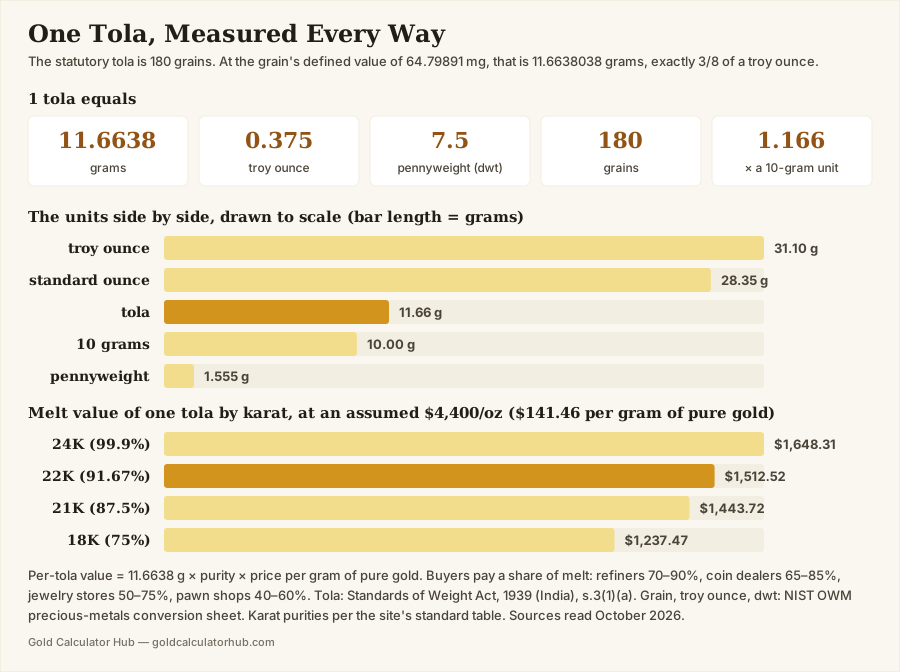
One tola is 180 grains, which is 11.6638038 grams, exactly three-eighths of a troy ounce. That is the legal definition, not a market convention, and every number on this page follows from it.
To use the calculator above, multiply your tolas by 11.6638 and enter the result in grams, then pick the karat. South Asian jewelry is usually 22K (stamped 916), but check the hallmark rather than assuming. Below you will find where the figure comes from, a conversion table you can print, per-tola values for four karats, a way to compare a per-tola quote against a per-10-gram quote, and two worked examples taken from questions people actually type into search engines.
Where 11.6638 Grams Comes From
The tola is old, but its weight is not a matter of opinion. British India's Standards of Weight Act, 1939 put it in a single line: "The standard tola, being a weight of 180 standard grains." The same section defines the seer as 80 tolas and lists the smaller units, which we get to further down.
The grain is the hinge. It is the same grain that sits underneath the troy system used for gold in the United States and London. The NIST Office of Weights and Measures conversion sheet gives one troy ounce as 480 grains and 31.1034768 grams, which makes one grain 64.79891 milligrams. Multiply by 180:
180 × 0.06479891 g = 11.6638038 g
And because a troy ounce is 480 grains, a tola is 180 ÷ 480 = 0.375 troy ounce. Eight tolas make exactly three troy ounces. That tidy ratio is the reason a tola price and an international ounce price translate so cleanly: a tola of pure gold is always three-eighths of the ounce price.
India moved to metric weights after 1956, and the 1939 Act was repealed along the way, so the tola is no longer a legal trading unit there. It never stopped being a household one. You will also see it written as 11.664 g (rounded to three decimals) or 11.66 g. Both are fine for a single bangle. They start to matter on larger weights, as the 120-tola example below shows.
Tola, Gram and Troy Ounce Conversion Table
Every row is the count of tolas × 11.6638038 g. Troy ounces are tolas × 0.375; pennyweight (the unit US jewelers weigh in) is tolas × 7.5.
| Tolas | Grams | Troy ounces | Pennyweight (dwt) |
|---|---|---|---|
| 1 | 11.664 | 0.375 | 7.5 |
| 2 | 23.328 | 0.75 | 15 |
| 3 | 34.991 | 1.125 | 22.5 |
| 5 | 58.319 | 1.875 | 37.5 |
| 7.5 | 87.479 | 2.8125 | 56.25 |
| 10 | 116.638 | 3.75 | 75 |
| 20 | 233.276 | 7.5 | 150 |
| 50 | 583.190 | 18.75 | 375 |
| 100 | 1,166.380 | 37.5 | 750 |
| 120 | 1,399.656 | 45 | 900 |
Going the other way: grams ÷ 11.6638 = tolas, so a kilogram is 85.74 tolas. If you need grains, baht or tael as well, the gold weight calculator handles every unit in one place.
What One Tola Is Worth at Each Karat
Assume gold at $4,400 per troy ounce, which works out to $141.46 per gram of pure gold. Per-tola melt value is then 11.6638 g × purity × $141.46.
| Karat | Purity | Per gram | Per tola | Pure gold in one tola |
|---|---|---|---|---|
| 24K | 99.9% | $141.32 | $1,648.31 | 11.652 g |
| 22K | 91.67% | $129.68 | $1,512.52 | 10.692 g |
| 21K | 87.5% | $123.78 | $1,443.72 | 10.206 g |
| 18K | 75% | $106.10 | $1,237.47 | 8.748 g |
A sanity check needs no calculator at all: spot price × 0.375 × purity. For 22K, $4,400 × 0.375 × 0.9167 = $1,512.55, within three cents of the table (the gap is rounding in the per-gram price). These are melt values, the floor of what the metal is worth, not what a buyer hands over.
If your piece is 22K, the 22K gold calculator goes further on that karat alone, including how per-gram and per-tola figures move with the market.
A 10-Gram Rate Is Not a Tola Rate
Here is the most expensive mix-up on this page. Plenty of gold rates are published per 10 grams, not per tola. India's bullion benchmark is one example: the India Bullion and Jewellers Association rate page labels its figures "Gold rates per 10gm" and notes they exclude 3% GST and making charges (read October 2026). A 10-gram figure looks like a tola figure, sits in the same place on a rate board, and is 14.3% smaller, because a tola is 1.16638 times ten grams.
The fix is one multiplication:
- Per-10 g rate → per-tola rate: × 1.16638
- Per-tola rate → per-10 g rate: ÷ 1.16638
- Either one → per gram: divide by 10, or by 11.6638
So a board showing $1,300 per 10 g of 22K is quoting $1,516.29 per tola, and a $1,516.29 tola quote is $130.00 per gram. Same price, three costumes. If you read the 10-gram figure as a tola price, you would think the gold was about $216 a tola cheaper than it is, and you would accept an offer that is short by the same margin.
We are not going to tell you which unit a particular city's jewelers use today; that changes by market and by shop, and we have not surveyed them. What you can do is ask one question before you compare anything: "Is that per tola, per 10 grams, or per gram?" If the answer is vague, the quote is not ready to compare.
Converting a Local Quote Into Something Comparable
Suppose you are selling 22K jewelry and two buyers give you prices in different units. Buyer A offers $1,290 per tola. Buyer B offers $1,120 per 10 grams. B's number is smaller. B's offer is better.
That conversion is all a gold price per tola calculator does under the hood, and it takes three steps by hand:
- Convert both to dollars per gram. A: $1,290 ÷ 11.6638 = $110.60/g. B: $1,120 ÷ 10 = $112.00/g.
- Work out 22K melt per gram at the same moment. At our assumed price, $141.46 × 0.9167 = $129.68.
- Divide offer by melt. A pays 85.3% of melt; B pays 86.4%.
On a 50-gram set that gap is (112.00 − 110.60) × 50 = $70, which is real money for one question about units. Both offers sit inside the 70–90% band that online refiners and the better coin dealers typically pay, so neither buyer is out of line; one is simply better, and the unit hid it. The gold price per gram calculator shows live per-gram melt for every karat, which is the number you should divide by.
The same method works for buying, where the figure you compare is the price above melt (making charges and premium) rather than the share below it.
Three Tolas of 22K, Start to Finish
"I have 3 tolas of gold, how many grams is it?" is one of the questions that brought this page into existence, so let's answer it completely and then keep going to dollars.
You could skip straight to a gold price per tola calculator, but doing it once by hand shows exactly where the money is.
Grams. 3 × 11.6638 = 34.99 g. If the family figure is "three tola," put the jewelry on a scale anyway; remembered weights are often rounded, and any stones, lac fill or non-gold clasps add weight that is not gold.
Pure gold. At 22K: 34.99 × 0.9167 = 32.08 g of fine gold.
Melt value. 32.08 × $141.46 = $4,538 at an assumed $4,400 per troy ounce.
What buyers would pay, using the usual share-of-melt bands:
| Buyer type | Share of melt | Offer for 3 tolas of 22K |
|---|---|---|
| Online refiner | 70–90% | $3,176–$4,084 |
| Local coin/bullion dealer | 65–85% | $2,949–$3,857 |
| Jewelry store | 50–75% | $2,269–$3,403 |
| Pawn shop | 40–60% | $1,815–$2,723 |
| Mail-in TV service | 20–50% | $908–$2,269 |
The spread between the best and worst outlets on the same 35 grams is more than $3,000. Every selling guide on this site boils down to the same lesson: know your weight and karat, and get more than one quote.
The 120-Tola Question
Another real search: "gold weight calculator, tulas to grams, total 120 tulas." The conversion is quick: 120 × 11.6638038 = 1,399.66 g, just under 1.4 kilograms, or exactly 45 troy ounces.
If that is 22K jewelry, the fine gold is 1,399.66 × 0.9167 = 1,283.07 g, worth about $181,502 in melt at $4,400 per ounce. If it is 24K bar or coin, it is about $197,797.
At this size, rounding stops being harmless. Using 11.66 g instead of 11.6638 g drops 0.46 g across 120 tolas, about $59 of 22K gold, which is tolerable. Treating a tola as 10 grams drops 199.66 g, roughly $25,891 of 22K melt, which is not. A lot this large also deserves a written assay and offers from more than one refiner rather than a counter quote, and a gold calculator estimate is the starting point for that conversation, not the end of it.
Masha and Rati: The Smaller Pieces
Old receipts and family notebooks sometimes go below the tola. The 1939 Act's own table of sub-multiples sets them out:
- 1 masha = 1/12 tola = 0.972 g
- 1 rati = 1/96 tola (one-eighth of a masha) = 0.1215 g
- ½ tola = 6 masha; ¼ tola = 3 masha
So "2 tola 4 masha" is 2 × 11.6638 + 4 × 0.972 = 27.22 g. Convert each part to grams, add, and only then apply purity. The 916 gold price calculator page also covers the South Indian sovereign, which is a separate 8-gram unit and easy to confuse with the British coin of the same name.
A Note on Zakat
The tola-based gold nisab is 7.5 tola, which is 87.48 g; other scholars use 85 g, and schools differ on whether worn jewelry counts. The zakat on gold calculator lays out both conventions; treat it as arithmetic, not a religious ruling, and confirm your obligation with a scholar you trust.
Frequently Asked Questions
Why do some people say a tola is 10 grams?
Usually because a 10-gram price and a tola price get treated as the same thing. Many gold rates are published per 10 grams, and over time the two figures blur together in conversation. They are different: the defined tola is 11.6638 g, about 16.6% heavier than 10 g. If someone weighs or prices your gold using a 10-gram 'tola,' ask them to restate the figure in grams so you can check it against a scale and a per-gram melt price.
How many tolas are in a kilogram of gold?
About 85.74. Divide 1,000 g by 11.6638 g. For a 100-gram bar the answer is 8.57 tolas, and for a troy ounce it is 2.67 tolas (480 ÷ 180). If you are comparing a kilo-bar price with a per-tola price, convert both to per gram first; it removes every chance of dividing by the wrong number.
How much is a 10-tola bar worth?
Ten tolas is 116.638 g. If the bar is stamped 999, it contains 116.52 g of fine gold, worth about $16,483 at an assumed $4,400 per troy ounce ($141.32 per gram of 999 gold). Bars also carry a resale premium or discount depending on the brand and the buyer, so treat melt as the reference, check the bar's markings, and get a live figure by entering 116.638 g in the calculator above.

Written by Sukie Gao
Sukie Gao holds a master's degree from a business school, where she picked up the markets-and-pricing toolkit she now applies to the consumer gold trade. She created Gold Calculator Hub to give people an independent, data-driven way to find out what their gold is really worth.
Published October 31, 2026 · Updated November 14, 2026