How Much Is White Gold Worth? 10K, 14K and 18K Values per Gram
 By Sukie Gao · Updated November 14, 2026
Quick answer
Exactly as much as yellow gold of the same karat, because buyers pay for gold content and color adds nothing at the scale. With gold assumed at $4,400 per troy ounce, a gram of 10K white gold holds about $58.95 of gold, 14K about $82.52 and 18K about $106.10. Worn or yellowing rhodium plating does not lower that melt figure either. So how much is white gold worth when you sell? A share of melt, roughly 70–90% from an online refiner and 40–60% from a pawn shop.
How Much Is White Gold Worth? 10K, 14K and 18K Values per Gram
Live gold price: $3,887.60/ozt · Nov 14, 3:21 PM EST · updates every 10 min
Melt value of 10 g of 14K gold
$729.06
Pure gold content: 5.83 g × $124.99/g
| Where you sell | Typical offer | % of melt |
|---|---|---|
| Online gold refiner | $510.34 – $656.16 | 70–90% |
| Local coin / bullion dealer | $473.89 – $619.70 | 65–85% |
| Jewelry store | $364.53 – $546.80 | 50–75% |
| Pawn shop | $291.62 – $437.44 | 40–60% |
| Mail-in 'cash for gold' TV services | $145.81 – $364.53 | 20–50% |
Ranges reflect typical published buy rates and consumer-test results. We are not a buyer — these numbers exist so you can judge any offer you receive.
How much is white gold worth? Exactly as much as yellow gold of the same karat and weight, because a buyer pays for the gold inside and nothing else. At an assumed $4,400 per troy ounce, a gram of 10K white gold holds $58.95 of gold, 14K holds $82.52 and 18K holds $106.10.
The white color comes from the metals mixed in with the gold, usually nickel or palladium, and from a thin rhodium plating on the surface. None of that is paid for when the piece is sold as scrap. The karat stamp tells you how much gold is in the alloy; the color tells you nothing about value.
The calculator above is set to 14K, the most common white gold in American jewelry, and runs at the live price; switch the karat to 10K or 18K if your stamp says so. Below it you will find one table covering all three karats by weight, a worked 5-gram example priced at every type of buyer, a guide to telling white gold from sterling silver and platinum by the stamp, and the deductions a buyer may try on a white piece, with notes on which ones are fair.
Why the color is worth nothing at the scale
White gold is not its own metal. It is ordinary karat gold whose other ingredients bleach the color: nickel in many older and cheaper alloys, palladium in many newer ones. A 14K white ring and a 14K yellow ring both contain 58.33% gold by weight. They differ only in what makes up the other 41.67%, and that portion is exactly what a refiner removes and does not pay for.
Three parts of a white gold piece add nothing to its scrap value:
- Rhodium plating. Most white gold jewelry is plated with rhodium to give it a bright, cold white finish. The layer is extremely thin, and at the buyer's counter it has no recoverable value. Federal rules treat it as something the seller of new jewelry must disclose: 16 CFR § 23.7 says it is deceptive not to disclose a surface-layer application of rhodium on products marked or described as precious metal.
- Nickel. It is a base metal, and nobody pays for it in a jewelry lot.
- Palladium. This is the only possible exception. Palladium is a precious metal, and some refiners recover it and pay a small amount for it on large lots. Consumer-facing buyers (coin shops, jewelers, pawn shops) almost never do, so a white gold ring will be quoted on its gold content alone, whatever it is alloyed with.
So the answer to how much is white gold worth comes from the same arithmetic as yellow gold: weight × purity × the price of a gram of pure gold. At $4,400 per troy ounce, pure gold is $141.47 per gram (4,400 ÷ 31.103). Multiply by 0.4167 for 10K, 0.5833 for 14K or 0.75 for 18K. If you want the full karat-by-karat breakdown with payouts for one karat, the 10K gold value guide and the 14K gold value guide cover each in depth. This page covers the white gold side: identification, deductions and the comparison across karats.
10K vs 14K vs 18K white gold: one table, every common weight
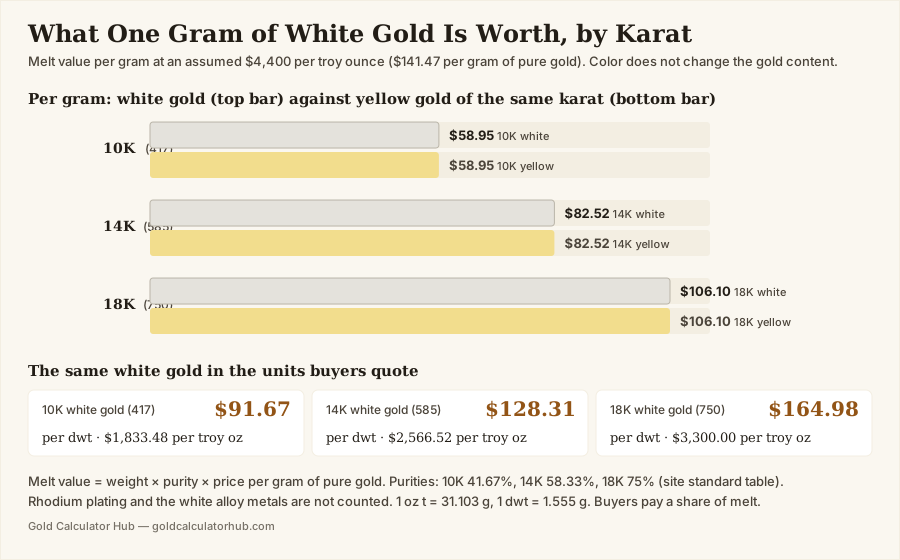
Read down to your weight and across to your stamp. Every figure is melt value, the gold content priced at the assumed $4,400 per troy ounce, before any buyer takes a cut. Because the values scale in a straight line, you can add rows together: 7 g is the 5 g row plus the 2 g row.
| Weight | 10K white (417) | 14K white (585) | 18K white (750) |
|---|---|---|---|
| 1 gram | $58.95 | $82.52 | $106.10 |
| 1 pennyweight (1.555 g) | $91.67 | $128.31 | $164.98 |
| 2 grams | $117.90 | $165.03 | $212.20 |
| 3 grams | $176.85 | $247.55 | $318.30 |
| 5 grams | $294.74 | $412.58 | $530.50 |
| 10 grams | $589.49 | $825.17 | $1,060.99 |
| 20 grams | $1,178.97 | $1,650.34 | $2,121.98 |
| 1 troy ounce (31.103 g) | $1,833.48 | $2,566.52 | $3,300.00 |
| 50 grams | $2,947.43 | $4,125.84 | $5,304.95 |
Two patterns are worth noticing. First, the step between karats is almost exactly the same in dollars: 14K is worth $23.57 more per gram than 10K, and 18K is $23.58 more than 14K, because each step adds about four twenty-fourths of gold. Second, 10K holds only 71% of the gold of the same weight of 14K, so a 10K white chain that looks identical to a 14K one is worth about 29% less. Treat the table as a ruler, not a quote, and use the gold calculator for today's figure.
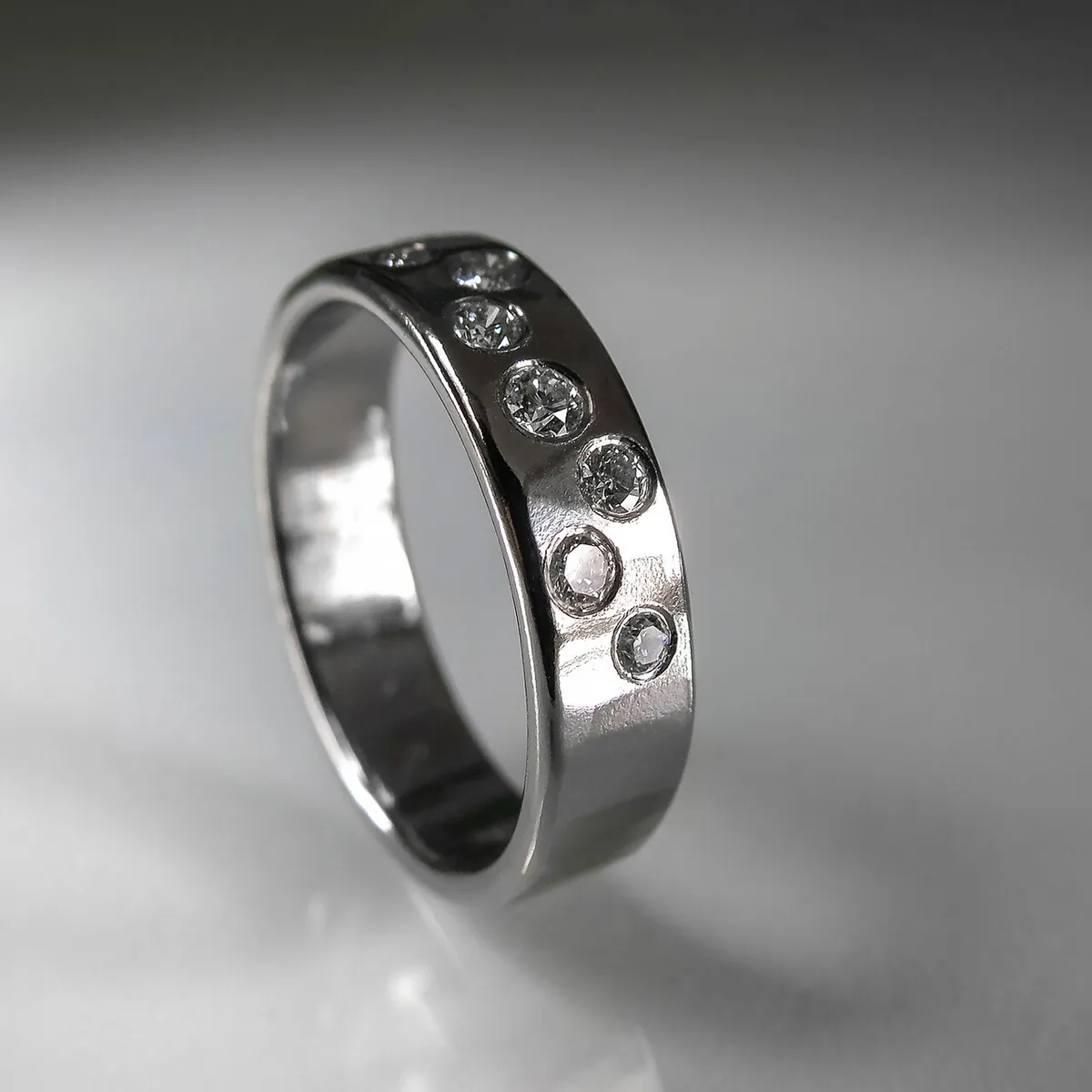
Worked example: what a 5-gram 14K white gold band fetches at each buyer
Take an illustrative plain 14K white gold wedding band weighing 5.0 grams on a scale that reads to a hundredth of a gram, stamped 14K inside, with no stones. This is the case behind one of the most common searches on the subject: what 5 grams of 14K white gold is worth.
- Gold content: 5.0 g × 0.5833 = 2.92 g of pure gold.
- Melt value: 2.9165 g × $141.47 = $412.58 at $4,400 per troy ounce.
- Apply each buyer's typical share of melt.
| Buyer type | Typical share of melt | Offer on $412.58 |
|---|---|---|
| Online refiner | 70–90% | $288.81–$371.33 |
| Local coin or bullion dealer | 65–85% | $268.18–$350.70 |
| Jewelry store | 50–75% | $206.29–$309.44 |
| Pawn shop | 40–60% | $165.03–$247.55 |
| Mail-in TV service | 20–50% | $82.52–$206.29 |
The spread between the best and worst door is about $289 on a single plain band. That is far more than any price move in gold you would see in a normal week. On a lot this small, a refiner's shipping and insurance cost eats into the advantage, so for one band the practical choice is usually a local coin dealer quoting at the top of its range.
A second case: the stone is not gold
Now take an illustrative 18K white gold engagement ring that weighs 4.2 g in total and holds a 0.50-carat diamond. A carat is 0.2 g, so the stone weighs 0.1 g and the metal weighs 4.1 g. Melt value is 4.1 × 0.75 × $141.47 = $435.01. If the ring is weighed whole and priced as if it were all metal, you get $445.62, which overstates the gold by $10.61. A buyer will remove that amount (or more, if the setting is heavy). The diamond is a separate question: gold buyers pay nothing for it, and it is worth having it looked at by someone who buys stones before you let it go with the scrap. On the 4.1 g of metal, a refiner's 70–90% works out to $304.50–$391.51 and a pawn shop's 40–60% to $174.00–$261.00.
White gold, silver or platinum? The stamp decides before the scale does
Three white metals are easy to confuse across a counter, and their values are completely different. The color will not tell them apart, but the stamp usually will.
- White gold carries a karat mark (10K, 14K, 18K, sometimes with KT or KP) or its parts-per-thousand equivalent: 417 for 10K, 585 for 14K (older or European pieces sometimes read 583), 750 for 18K. The FTC's Jewelry Guides treat calling an alloy below 24K "gold" without a correct karat fineness in front of the word as misleading (16 CFR § 23.3).
- Sterling silver is marked 925, Sterling or Ster. Under 16 CFR § 23.5 those terms require at least 925/1,000 pure silver. A 925 ring plated with rhodium can look exactly like white gold. It is worth a small fraction as much, because silver trades at a tiny fraction of gold's price per gram.
- Platinum is marked PLAT, Pt, or a fineness such as 950Pt or 900Plat. Under 16 CFR § 23.6 the unqualified word Platinum means at least 950 parts per thousand. Platinum is priced on its own market, so its value has to be worked out from the platinum price, not the gold table above. It also feels noticeably heavier than white gold of the same size.
Two mixed stamps cause most of the confusion. A piece marked 14K/925 or 14K & Sterling is mostly silver with gold accents; the FTC rules give "14K/Sterling" on a product with more silver than gold by weight as an example of a misleading description, and expect the predominant metal to be listed first (§ 23.8). And 14K GP, HGE or GEP means plated, not solid: a thin gold electroplate over a base metal, worth essentially nothing for its gold.
Also keep in mind that legal fineness has a tolerance. Under the National Stamping Act, cited in § 23.3(d), a karat-gold article with no solder may test up to three parts per thousand below its mark, or seven parts per thousand if the tested part contains solder. That is too small to matter on one ring. For the full list of maker's marks, foreign hallmarks and what they mean, see the gold hallmarks guide.
Deductions a buyer may take on white pieces, and how to answer them
A buyer pays a percentage of melt for good reasons: refining costs money, and gold can fall between purchase and pour. Some deductions on white gold are fair. Others are just negotiating.
Fair: stones, springs and non-gold parts. Stones, the steel spring inside a lobster clasp, and any pin or back marked differently from the main piece should come off the weight. Ask the buyer to separate them in front of you, or remove what you can before you go.
Fair: an unmarked or doubtful piece tests low. If a white ring has no stamp, the buyer will acid-test or use an XRF analyzer, and it is reasonable for them to price it at the karat the test shows rather than the karat you hoped for.
Questionable: a lower per-gram rate because the piece is white. Gold content is set by the karat, not the color. Some buyers argue that white alloys cost more to refine. That may be true at the refinery, but it is already built into the percentage of melt they are offering. A separate, lower white-gold rate on top of that is a second cut. Ask for the per-gram rate they would pay for the same karat in yellow, and expect it to match.
Not a deduction: worn rhodium. A white ring that has gone slightly yellow at the high points has lost some of its plating, not its gold. The karat is unchanged and so is the value.
Not an extra either: palladium. If a buyer will not pay more for a palladium-white piece, that is normal; very few consumer-level buyers do. Do not walk away from a fair gold offer on the expectation of a palladium premium.
The practical routine is the same for every color of gold: know the karat and weight before you go, get more than one offer, and watch the scale. White gold just adds the color argument to the list of things to recognize.
Sell, keep or re-plate?
For a plain band, a broken chain or a single earring, scrap is usually the right call, and the table above tells you what the gold is worth. For a piece someone could still wear, it is worth one more step before selling for melt.
White gold that looks tired is usually only worn plating. A jeweler can re-plate it with rhodium, and once it looks new again, it may sell to a person or a jewelry store's resale case for more than its scrap value. Whether that pays depends on the piece. For a small 10K item worth a couple of hundred dollars at melt, re-plating costs and the time to sell it privately often eat the difference. For an 18K piece with a recognizable maker's mark, they often do not.
If you are keeping white gold as a store of value, think of it as jewelry, not as an investment. You pay a retail markup when you buy it and get back a share of the gold content when you sell, so the round trip loses money unless the gold price rises a great deal in between. For that purpose, bullion coins and bars carry a much smaller gap between buying and selling price. Whatever you decide, how much is white gold worth in your case comes down to the same three numbers every time: the karat stamp, an accurate gram weight, and the live price in the calculator above.
Frequently Asked Questions
Is 18K white gold worth more than 14K yellow gold?
Yes, gram for gram, because 18K has more gold in it. 18K is 75% gold and 14K is 58.33%, so a gram of 18K white gold holds $106.10 of gold at $4,400 per troy ounce, against $82.52 for a gram of 14K yellow. The color has nothing to do with it: 18K yellow and 18K white are worth exactly the same at melt.
What does 585 mean on a white ring?
It means the alloy is 585 parts per thousand gold, which is 14K. Many European and Asian makers stamp the parts-per-thousand number instead of a karat mark, and older pieces sometimes read 583. Either way, price it as 14K. If the 585 sits next to another mark, such as 925, read the whole stamp, because a mixed mark can mean the piece is mostly silver.
Will a buyer pay less for white gold than yellow?
They should not pay a lower per-gram rate for the same karat. Gold content is fixed by the karat, and refining costs are already built into the percentage of melt every buyer offers. It is fair for a buyer to deduct the weight of stones and clasp springs, or to price an unmarked piece at what it tests. A separate discount just because the piece is white is worth questioning, and worth a second quote.

Written by Sukie Gao
Sukie Gao holds a master's degree from a business school, where she picked up the markets-and-pricing toolkit she now applies to the consumer gold trade. She created Gold Calculator Hub to give people an independent, data-driven way to find out what their gold is really worth.
Published November 4, 2026 · Updated November 14, 2026