Gold Price per Pennyweight Calculator (dwt) by Karat
 By Sukie Gao · August 2, 2026
A gold price per pennyweight calculator exists because of a mismatch nobody warns sellers about: American jewelry buyers quote in pennyweights, and almost nobody outside the trade owns a scale set to them. So you arrive knowing your gold in grams, get quoted in dwt, and have no instinct for whether the number is generous or insulting.
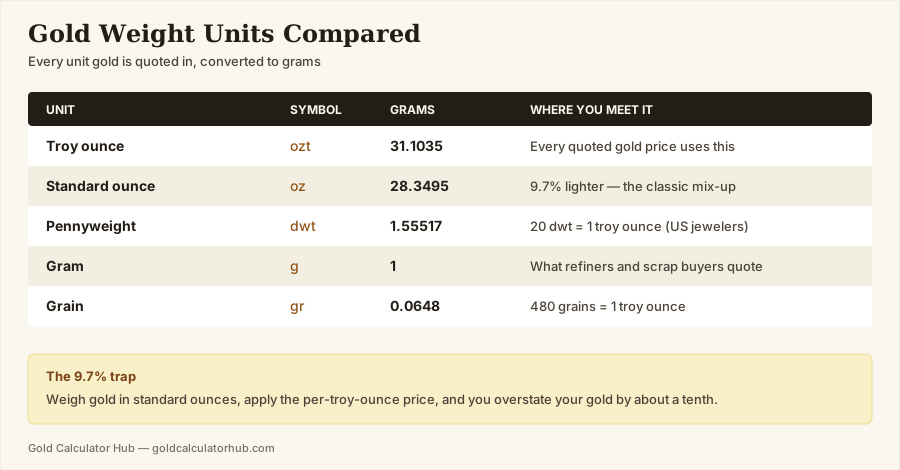
Here is the fact that resolves it. One pennyweight is 1.555 grams — twenty of them to a troy ounce. Because a dwt is heavier than a gram, any per-dwt price is 55.5% larger than the identical per-gram price for the same gold. That is not a discount or a premium. It is a unit, doing what units do. But it is also the single most reliable source of confusion at a gold counter in the United States.
Use the calculator above with your weight and karat, then work through the tables below to see what every karat is worth per pennyweight, and how to convert a dwt quote back into something you can judge.
1 dwt = 1.555 Grams, and Everything Follows
The pennyweight belongs to the troy system, the weight standard the precious metals world has used for centuries. Its structure is simple and worth memorizing in one line:
20 pennyweight = 1 troy ounce = 31.103 grams. Therefore 1 dwt = 1.555 grams.
The abbreviation dwt looks like a typo for something but is not — the d is inherited from the old English penny, whose Latin-derived symbol survived long after the coin's weight stopped meaning anything. The unit itself outlived its own etymology by a few hundred years and is still printed on jewelry scales sold today.
Because 20 dwt make exactly one troy ounce, the pure-gold pennyweight rate is the easiest conversion in the entire trade: divide the spot price by 20. At an assumed spot of $4,450 per troy ounce, pure gold runs $222.50 per pennyweight. Every karat rate on this page is that figure multiplied by a purity fraction — nothing more complicated is happening anywhere below.
Why the Trade Still Quotes This Way
Two reasons, one innocent and one less so.
The innocent one is inertia with infrastructure attached. American jewelry manufacturing, casting, and repair have used pennyweights for generations. Casting weights, findings catalogs, bench scales, and the vocabulary of every jeweler trained before roughly 2000 are all in dwt. A buyer quoting per pennyweight is usually just speaking the language of the room they trained in, and switching would mean rebuilding decades of internal reference points for no gain.
The less innocent one is that bigger units produce bigger numbers, and bigger numbers feel more generous. "I can do $110 a pennyweight on your 18K" lands differently than "$70.74 a gram," even though they are the same offer to the cent. No law is broken and no false statement is made. The seller simply has no reference frame in that unit, and reference frames are where negotiating power lives.
The cure is not suspicion, it is arithmetic. Divide any per-dwt quote by 1.555 and you are back on ground you understand.
Every Karat, per Pennyweight and per Gram
Worked at an assumed spot of $4,450 per troy ounce — so pure gold is $222.50 per dwt and $143.07 per gram. Recheck against the live calculator above before selling anything.
| Karat | Purity | Stamp | Per pennyweight | Per gram |
|---|---|---|---|---|
| 24K | 99.9% | 999 | $222.28 | $142.93 |
| 22K | 91.67% | 917 | $203.97 | $131.16 |
| 21K | 87.5% | 875 | $194.69 | $125.19 |
| 18K | 75% | 750 | $166.88 | $107.30 |
| 14K | 58.33% | 585/583 | $129.78 | $83.45 |
| 10K | 41.67% | 417 | $92.72 | $59.62 |
| 9K | 37.5% | 375 | $83.44 | $53.65 |
Read the two right-hand columns side by side and the whole point of this page becomes visual. Fourteen karat gold at $129.78 per dwt and $83.45 per gram is the same metal at the same moment. If a shop quotes you the first figure and you mentally compare it against a per-gram number you looked up at home, you will conclude they are paying above market — which they are not, and which is exactly the misreading to avoid.
The Trap, Stated Plainly
Multiply any per-gram gold price by 1.555 and you get the per-dwt price. That is a 55.5% larger number describing 55.5% more metal. Nothing gained, nothing lost.
The failure happens when a seller carries a per-gram figure in their head and hears a per-dwt figure at the counter without noticing the unit changed. Say you researched 14K at home and found roughly $83 a gram. At the shop, someone offers "$85 a pennyweight." It sounds like you are being paid slightly over the market value you researched. Convert: $85 ÷ 1.555 = $54.66 per gram, which against a melt value of $83.45 per gram is 65% of melt. That is a fine pawn-adjacent offer and a poor dealer offer, but it is nowhere near the "slightly above market" it impersonated.
The reverse error also exists and costs sellers real money in a quieter way: someone quoted honestly in dwt assumes it must be inflated, refuses a genuinely strong 85%-of-melt offer, and sells worse somewhere else a week later. Units cut both directions. The habit that protects you is mechanical, not clever — every quote gets divided by 1.555 before you have an opinion about it.
Conversions You Will Actually Need
| Weight | In grams | In pennyweight | In troy ounces |
|---|---|---|---|
| 1 dwt | 1.555 | 1 | 0.05 |
| 5 dwt | 7.775 | 5 | 0.25 |
| 10 dwt | 15.55 | 10 | 0.5 |
| 20 dwt | 31.103 | 20 | 1 |
| 1 g | 1 | 0.643 | 0.0322 |
| 10 g | 10 | 6.43 | 0.322 |
| 25 g | 25 | 16.08 | 0.804 |
| 50 g | 50 | 32.15 | 1.608 |
The two directions to remember: dwt × 1.555 = grams, and grams ÷ 1.555 = dwt. Everything else in the table is those two operations applied.
Also worth flagging because it compounds with the pennyweight confusion: the ounce on your kitchen scale is not a troy ounce. A standard avoirdupois ounce is 28.350 grams against the troy ounce's 31.103 — about 8.8% lighter. If you weigh in kitchen ounces, convert to troy ounces, then convert to pennyweights, you will be wrong twice in the same direction. Weigh in grams and convert once. Troy ounce vs ounce walks through that second trap in detail.
A Real Offer, Converted Step by Step
Bring in a specific lot: 24.5 pennyweight of solid 14K, stones removed, sorted by stamp. At our assumed $4,450 spot, 14K melts at $129.78 per dwt.
- Weight in grams: 24.5 × 1.555 = 38.10 g
- Melt value: 24.5 × $129.78 = about $3,179
- Cross-check in grams: 38.10 × $83.45 = about $3,179. The two routes agree, which is how you know the conversion did not go sideways.
Now price two quotes against it.
Quote A: $95 per pennyweight. Convert: $95 ÷ 1.555 = $61.09 per gram. Against melt of $83.45 per gram, that is 73% of melt — total offer about $2,328. Respectable for a walk-in, roughly what a decent local dealer or a good jewelry store pays.
Quote B: $70 per pennyweight. Convert: $70 ÷ 1.555 = $45.02 per gram, or 54% of melt — total offer about $1,715. That is pawn-shop territory, which is fine if you need cash today and poor if you do not.
The gap between the two quotes is $613 on the same 38 grams. Neither buyer said anything untrue. The only variable was whether you could convert.
What the Payout Tiers Look Like in dwt
Since dwt is the unit you will be quoted in, it helps to know what each buyer tier looks like expressed that way. For 14K at our assumed $4,450 spot, where melt is $129.78 per pennyweight:
| Buyer type | % of melt | Offer per dwt of 14K |
|---|---|---|
| Online refiner | 70–90% | $90.85 – $116.80 |
| Local coin / bullion dealer | 65–85% | $84.36 – $110.31 |
| Jewelry store | 50–75% | $64.89 – $97.34 |
| Pawn shop | 40–60% | $51.91 – $77.87 |
Carry this shape rather than the exact numbers, since spot moves. A per-dwt 14K quote in the $110–$117 range is excellent. In the $85–$110 range it is normal and worth comparing. Below $80 you are being paid convenience rates, which is a legitimate trade if you want the money today, and a bad one if you do not. What percentage do gold buyers pay explains the cost structures behind each band.
Reading a Scale That Displays dwt
Most jewelers' bench scales toggle between g, dwt, ozt, and sometimes plain oz, and the unit indicator is usually a small three-character label at the edge of the display. It is easy to miss and easy to change.
When you are watching a weighing, read the unit before you read the number. A reading of 24.5 is 24.5 grams or 24.5 pennyweight depending on a setting, and those differ by 55.5% — the largest single error available in the whole transaction. Ask the buyer to say the unit out loud as they weigh; it is a completely normal request and no honest counter will bristle at it.
Two more things worth insisting on. The scale should be legal for trade, which in most US jurisdictions means it carries a certification sticker with an inspection date — the FTC's selling gold jewelry guidance recommends buyers who weigh openly on certified equipment. And the weighing should happen in front of you, not in a back room. If your gold leaves your sight to be weighed, you have no idea what came back.
If you want to arrive with your own number, a pocket scale reading to 0.1 g costs about as much as a takeout dinner. How to weigh gold covers what to buy and how to avoid the usual mistakes.
The Mixed-Lot Problem, in Pennyweight Form
Almost every real scrap lot is mixed — a couple of 10K class rings, some 14K chain, an 18K pendant from a trip abroad. Weighing it as one pile and applying a single per-dwt rate is fast, and it always resolves in the buyer's favor.
Run the numbers at our assumed spot. Say a 30 dwt lot is 20 dwt of 14K and 10 dwt of 18K. Priced correctly: (20 × $129.78) + (10 × $166.88) = $2,595.60 + $1,668.80 = $4,264.40 of melt. Priced as though the entire pile were 14K: 30 × $129.78 = $3,893.40. The shortcut costs $371 before any payout percentage is even applied — and then the percentage shrinks it further.
So: sort by stamp yourself, at your own table, before you go. Group 585/583 together, 750 together, 417 together, and put anything unstamped or marked GF, GP, or HGE in a separate bag to be tested. Then ask for each group to be weighed and quoted separately. Buyers who work honestly do this by default. Buyers who sigh at the request have told you something useful. The scrap gold calculator is built for exactly this kind of multi-karat lot, and karat gold calculator covers the per-karat rates if you are working piece by piece.
Pennyweight Is an American Habit
If you have sold gold outside the United States, or read a price guide from abroad, you may never have encountered dwt at all. Most of the world's retail gold trade runs on grams, and the wholesale market runs on kilograms and troy ounces — the LBMA Good Delivery standards that govern bank-traded bars are specified in troy ounces, and you can read them at lbma.org.uk. Pennyweight survives mainly in American and Canadian jewelry and scrap counters.
That regional survival is why the confusion is so concentrated. A US seller researches gold prices online, finds gram-denominated information written for a global audience, then walks into a shop operating in a unit that global audience never mentions. The mismatch is structural, not adversarial.
It also means a gold price per pennyweight calculator is doing something genuinely useful rather than decorative. Enter a weight in whichever unit your scale reports, pick a karat, and it produces both the pennyweight and gram figures so a quote in either unit can be judged instantly. If you want the same math applied across a whole mixed lot with live pricing, the homepage gold calculator handles that in one pass.
Before You Accept Any dwt Quote
A short checklist, ordered by how much money each step tends to save:
- Divide by 1.555. Always. Before any reaction, positive or negative.
- Compute melt yourself first, in grams, and write it down. An offer you cannot express as a percentage of melt is an offer you cannot evaluate.
- Confirm what spot price the buyer is working from. It should match what your phone says within a few dollars.
- Sort by karat before weighing, and ask for separate quotes per group.
- Watch the weighing, and read the unit indicator on the display before the number.
- Get three quotes on anything above a few hundred dollars, including at least one online refiner to anchor the top of the range.
None of this is adversarial and none of it requires expertise you do not have. It requires one division and one multiplication, done before you are standing in front of someone waiting for an answer. For the karat that dominates American scrap and generates most pennyweight quotes, how much is 14K gold worth has the full weight-by-weight breakdown to price against.
Frequently Asked Questions
How many grams are in a pennyweight of gold?
1.555 grams, because twenty pennyweights make one troy ounce of 31.103 grams. That single ratio is all you need to move between the two units: multiply pennyweights by 1.555 for grams, or divide grams by 1.555 for pennyweights. Keep it handy on your phone when you go to sell, because it is the conversion that stands between you and correctly judging any quote an American jewelry buyer gives you.
Is gold priced per pennyweight more expensive than per gram?
No — it is the same gold at the same price, expressed in a unit 55.5% heavier. A per-dwt price will always look larger than the equivalent per-gram price for that exact reason. The mistake to avoid is comparing a per-dwt offer against a per-gram value you researched at home and concluding the offer is generous. Convert both to grams first, then compare, then form an opinion.
How do I calculate the melt value of 14K gold per pennyweight without a gold price per pennyweight calculator?
Divide the spot price by 20 to get pure gold per pennyweight (since 20 dwt make one troy ounce), then multiply by 0.5833 for 14K. At an assumed spot of $4,450, that is $222.50 × 0.5833 = $129.78 per dwt. Multiply by your pennyweight count for total melt. The calculator above does the same with the live price, which is the version to use on the day you actually sell.
Why do pawn shops and jewelers weigh in pennyweight?
Mostly training and equipment. American jewelry manufacturing, casting, and repair have run on pennyweights for generations, so bench scales, findings catalogs, and the professional vocabulary all use dwt. Some buyers also prefer it because a larger unit produces a larger-sounding number. Neither reason is dishonest, but only one of them is about convenience. Ask for the per-gram equivalent and any legitimate buyer will give it to you without friction.
How many pennyweights are in a troy ounce of gold?
Exactly twenty. That precision makes the pennyweight unusually easy to work with: the pure-gold price per dwt is simply the spot price divided by 20, no decimals involved. At $4,450 per troy ounce, pure gold is $222.50 per pennyweight. Multiply by the purity fraction of your karat — 0.75 for 18K, 0.5833 for 14K, 0.4167 for 10K — and you have the melt rate for your metal in the unit you will be quoted in.
What is a fair price per pennyweight for 14K gold?
Express it as a percentage of melt rather than a dollar figure, since spot moves. At an assumed $4,450 spot with 14K melt at $129.78 per dwt, a strong offer sits around $110–$117 (85–90% of melt), a normal one around $85–$110, and anything below roughly $80 is convenience pricing. Recompute melt at the current price before applying those bands, and always get a second quote on lots worth more than a few hundred dollars.
Can I use a kitchen scale to weigh gold in pennyweights?
Not directly — kitchen scales do not offer a dwt mode, and most round to whole grams, which is far too coarse for small jewelry. Weigh in grams on a scale that resolves to 0.1 g, then divide by 1.555 if you need pennyweights. Avoid the kitchen scale's ounce setting entirely: it reports avoirdupois ounces of 28.350 g, not the 31.103 g troy ounces gold is priced in, and stacking that error onto a dwt conversion compounds the mistake.
Do buyers pay a different percentage when quoting in pennyweight?
There is no systematic difference in the underlying percentage — the unit is presentational. What does change is how easy the offer is to evaluate on the spot, and offers that are harder to evaluate tend, on average, to be accepted more readily. That is a behavioral effect rather than a pricing one. Convert to grams, compute the percentage of melt, and the unit stops mattering entirely.
Does the pennyweight rate differ for white, yellow, or rose gold?
No. Color comes from the alloy metals mixed with the gold — nickel or palladium for white, extra copper for rose — and none of those are worth meaningful money at scrap volumes. A pennyweight of 14K white gold and a pennyweight of 14K yellow gold each contain the same 58.33% gold and melt to the same value. The rhodium plating on white gold is measured in microns and recovers nothing. A per-dwt discount offered for color is a negotiating move, not an assay result.

Written by Sukie Gao
Sukie Gao holds a master's degree from a business school, where she picked up the markets-and-pricing toolkit she now applies to the consumer gold trade. She created Gold Calculator Hub to give people an independent, data-driven way to find out what their gold is really worth.
Published August 2, 2026