Gold Bar Value Calculator: Bars, Premiums and Verifying What You Hold
 By Sukie Gao · November 20, 2026
Quick answer
Value equals the bar's stated weight times its fineness times the live gold price. A 1 oz bar at 999.9 holds 31.10 grams of pure gold, so at an assumed $143 per gram it is worth about $4,447. A kilo bar holds $143,071. A gold bar value calculator gives you that melt figure. Premiums can add 10% on small bars, so bar size changes what you actually pay.
Gold Bar Value Calculator: Bars, Premiums and Verifying What You Hold
Live gold price: $3,617.40/ozt · Nov 22, 8:29 PM EST · updates every 10 min
Melt value of 10 g of 14K gold
$678.39
Pure gold content: 5.83 g × $116.30/g
| Where you sell | Typical offer | % of melt |
|---|---|---|
| Online gold refiner | $474.87 – $610.55 | 70–90% |
| Local coin / bullion dealer | $440.95 – $576.63 | 65–85% |
| Jewelry store | $339.20 – $508.79 | 50–75% |
| Pawn shop | $271.36 – $407.03 | 40–60% |
| Mail-in 'cash for gold' TV services | $135.68 – $339.20 | 20–50% |
Ranges reflect typical published buy rates and consumer-test results. We are not a buyer — these numbers exist so you can judge any offer you receive.
If you hold a gold bar, a gold bar value calculator is the simplest tool on this site, because a bar is the one gold object with nothing to subtract. No stones, no clasps, no movement, no alloy guesswork. A bar states its weight and fineness on its face, and the value is those two numbers multiplied by the live gold price.
A 1 oz bar at 999.9 fineness contains 31.10 grams of pure gold. At $143 per gram, that is $4,447. A 100 g bar holds $14,300. A kilo bar holds $143,071.
What makes bars worth a page rather than a sentence is everything around the metal: premiums, which vary enormously with size and can quietly cost you 10% on small bars; refiner recognition, which determines whether a buyer accepts your bar or assays it; and verification, because bars are the most counterfeited form of gold precisely because they are the most anonymous. Get those three right and a bar is the most efficient way to hold gold there is.
Bar sizes and what each contains
At a pure gold price of $143.07 per gram (roughly $4,450 per troy ounce):
| Bar | Grams | Pure gold at 999.9 | Melt value |
|---|---|---|---|
| 1 g | 1 | 1.00 g | $143 |
| 5 g | 5 | 5.00 g | $715 |
| 10 g | 10 | 10.00 g | $1,431 |
| 1 troy oz | 31.103 | 31.10 g | $4,450 |
| 50 g | 50 | 50.00 g | $7,154 |
| 100 g | 100 | 100.00 g | $14,307 |
| 250 g | 250 | 250.00 g | $35,768 |
| 10 troy oz | 311.03 | 311.00 g | $44,497 |
| 500 g | 500 | 500.00 g | $71,536 |
| 1 kg | 1,000 | 1,000.00 g | $143,071 |
| Good Delivery (~400 ozt) | 12,441 | 12,440 g | $1,779,900 |
Because investment bars are 999 or 999.9 fine, the gross weight and the gold content are effectively the same number — which is exactly why bars are easier to value than anything else. There is no purity multiplier to remember.
Premiums: the number that actually varies
Every bar sells above spot and buys back below it. How far above is entirely a function of size.
| Bar size | Typical buy premium over spot |
|---|---|
| 1 g | 8–15% |
| 5 g | 5–9% |
| 10 g | 4–7% |
| 1 oz | 3–5% |
| 100 g | 2–4% |
| 500 g | 1.5–3% |
| 1 kg | 1–2% |
The reason is fixed cost. Minting, stamping, assaying, packaging and certifying a bar costs roughly the same whether the bar holds one gram or a thousand. Spread across one gram, that cost is a large percentage. Spread across a kilo, it is nearly invisible.
The practical consequence is stark: buying ten 10 g bars instead of one 100 g bar can cost you 3–4% extra, which on $14,000 is $500 for no benefit beyond divisibility. If you genuinely need divisibility, pay for it deliberately. If you are accumulating, buy the largest unit you can comfortably afford.
Selling works in reverse. A dealer buys a kilo bar close to spot and a one-gram bar at a wider discount, because they will have the same trouble reselling it that you had buying it.
Cast versus minted bars
Two manufacturing methods, and the difference affects both price and resale.
Cast (poured) bars are made by pouring molten gold into a mould. They have irregular surfaces, rounded edges and a slightly rustic appearance. They are cheaper to produce, so they carry lower premiums, and they are the standard for larger sizes.
Minted bars are cut from rolled sheet and struck like a coin, giving sharp edges, flat faces and precise detail. They usually arrive sealed in assay packaging. Premiums are higher, and the presentation makes them easier to sell to private buyers.
For pure accumulation, cast bars in larger sizes are the most efficient. For anything you might sell to an individual rather than a dealer, minted bars in sealed assay cards are easier to move because the packaging carries the assurance.
Neither is better metal. A cast kilo bar from Valcambi and a minted one contain identical gold.
Refiner recognition, and why it matters more than looks
A bar's liquidity depends heavily on who made it.
LBMA Good Delivery refiners — PAMP Suisse, Valcambi, Argor-Heraeus, Metalor, Perth Mint, Heraeus, Royal Canadian Mint, Rand Refinery and others on the accredited list — produce bars that dealers accept on sight, worldwide.
Unrecognised or generic bars may be perfectly good gold, but a buyer has to test them, and testing costs. Expect a wider discount when selling.
Bars with no refiner mark at all should be treated with real caution. Legitimate refiners mark their product; the absence of a mark is not proof of anything, but it removes every shortcut a buyer would otherwise use.
The implication when buying: the premium difference between a recognised and an unrecognised bar is smaller than the resale discount you will face. Paying an extra 1% for a PAMP or Valcambi bar is usually cheaper than the 3–5% you lose selling something nobody recognises.
The implication when selling: keep the assay card, the serial number and any original packaging. They are part of the product.
The accredited refiner list is maintained by the LBMA Good Delivery programme, which sets the purity, marking and assay standards a refiner must meet for its bars to be accepted without testing.
Verifying a bar you already own
Bars are the most counterfeited gold form, because a bar is anonymous in a way a coin is not — there is no intricate design to reproduce. Tungsten-cored fakes exist because tungsten's density is remarkably close to gold's.
Checks in order of accessibility.
Weight and dimensions. Gold's density is 19.32 g/cm³. A genuine 100 g bar has specific published dimensions from its refiner; measure and compare. A bar that is correct in weight but oversized is not solid gold.
Specific gravity. Weigh dry, then weigh submerged in water. Divide dry weight by weight loss. The result should be very close to 19.3 for 999 gold. This is non-destructive, needs only a scale and a cup, and catches most fakes — though not a well-made tungsten core, since tungsten sits at 19.25.
Magnetic slide test. A neodymium magnet slid down a tilted genuine gold bar decelerates smoothly due to eddy currents. Ferrous cores are caught outright.
Ping test. Gold rings with a characteristic high, long tone. Base metals sound dull. Phone apps exist that analyse the frequency.
Ultrasonic thickness testing is what dealers use for larger bars, and it detects internal cores that surface tests miss. Any reputable dealer will do this before buying a large bar.
Serial number verification. Modern PAMP and Valcambi bars carry serial numbers and, on some products, verification via the refiner's app or website.
Bars versus coins
| Bars | Coins | |
|---|---|---|
| Premium | Lower, especially at size | Higher, especially fractional |
| Recognisability | Depends on refiner | Universal for major coins |
| Divisibility | Poor above 100 g | Excellent |
| Tax status (UK) | CGT applies | Sovereigns (1837 on) and Britannias CGT-exempt |
| Counterfeit risk | Higher | Lower — harder to fake convincingly |
| Resale to individuals | Harder | Easier |
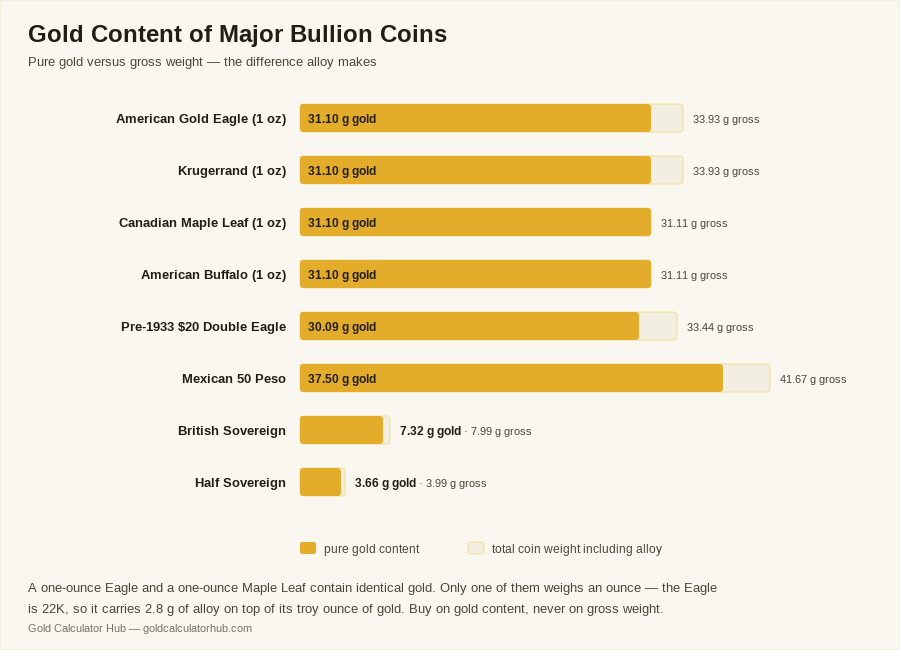
Bars win on cost per gram. Coins win on liquidity, divisibility, verification and — for UK residents holding Sovereigns or Britannias — tax.
A common approach among people holding meaningful amounts is a mix: bars for the bulk of the position where efficiency matters, coins for the portion that might need to be sold in pieces. That is not a rule, but it reflects the actual tradeoff rather than treating either form as strictly better.
Are lower-karat "gold bars" a thing?
Occasionally, and they need care.
Investment bars are 999 or 999.9. A bar marked 18 carat, 750, or anything below 995 is not investment bullion. Such bars exist — some jewelry manufacturers cast alloy into bar form for convenience, and some novelty items are made this way.
They have real value: an 18K bar weighing 100 g contains 75 g of pure gold, about $10,730 at $143 per gram. But they trade as scrap, not as bullion, because a refiner has to melt and separate them. Expect refiner scrap percentages of 70–90% rather than the near-spot pricing a 999.9 bar commands.
So the answer to "is an 18 carat gold bar worth anything" is yes, substantially — just value it with a scrap calculator and sell it to a refiner rather than a bullion dealer.
The same applies to anything described as a gold bar without a fineness stamp. Until fineness is established, treat it as unknown alloy.
Storage, insurance and practical ownership
Bars are dense and small, which is convenient and also a risk concentration.
Home storage costs nothing and is uninsured by default. Most homeowner's policies cap precious metals coverage at a low figure — often a few thousand dollars — so a kilo bar is effectively uninsured. Check your policy rather than assuming.
Bank safe deposit boxes are inexpensive but usually not insured for contents, and access is limited to banking hours.
Allocated professional vaulting typically costs 0.4–1.0% of value per year and includes insurance. On a $143,000 kilo bar that is $570–$1,430 annually. Allocated means specific serial-numbered bars are yours; unallocated means you own a claim, which is a materially different thing.
Keep the paperwork with the metal: assay cards, serial numbers, purchase invoices. They establish provenance, they support insurance claims, and they materially improve what a buyer will pay.
One practical note: do not break sealed assay packaging. The seal is a large part of what makes a minted bar easy to sell, and once broken the next buyer has to test.
Selling a bar: getting a fair number
Bars sell close to spot, which means the work is comparison rather than negotiation.
Get published buy prices from two or three online bullion dealers. Most publish live figures by product. That gives you a hard benchmark in five minutes.
Expect 1–4% under spot for a recognised bar in good condition with its assay card, with the discount narrowing as size increases.
Expect more if the bar is unrecognised, unpackaged, or damaged, because the buyer has to assay it.
Do not take a bar to a scrap gold buyer. A cash-for-gold operation pays a percentage of melt appropriate to jewelry — 40–60% is common — and a bar is worth vastly more than that at any bullion dealer. This is the single most expensive mistake available with bullion, and it happens because the nearest gold buyer is often a pawn shop.
For a Good Delivery bar or anything above a kilo, you are dealing with institutional channels and should expect due diligence on provenance in both directions.
Frequently Asked Questions
What does 999.9 mean on a gold bar?
99.99% pure gold, often called four nines. It is the standard for modern investment bars from major refiners. You will also see 999, meaning 99.9% or three nines, which is the ordinary bullion standard. The practical difference between them for a seller is one hundredth of one percent of the metal, so it should not change what you accept. The absence of any fineness mark, by contrast, is a genuine concern.
Do I need to keep the assay card with my gold bar?
Yes, and do not break the seal. Modern minted bars ship in tamper-evident packaging with a serial number matching an assay certificate, and that packaging is a substantial part of what makes the bar easy to sell — the next buyer can accept it without testing. Breaking the seal means the buyer has to assay the metal, which costs time and money and shows up as a lower offer. Store the invoice with it too, for insurance and provenance.
Are gold bars taxed differently from gold coins?
In the UK, yes and it matters. Investment gold — bars and coins meeting purity and form criteria — is VAT-exempt across the UK and EU. But Capital Gains Tax treatment differs: British Sovereigns minted from 1837 on and Britannias are UK legal tender and their gains are CGT-exempt, while gains on bars, Krugerrands and Maple Leafs are chargeable above the annual exemption. In the US, physical gold in any form is treated as a collectible by the IRS, with a maximum long-term rate of 28%. This is general information, not tax advice.

Written by Sukie Gao
Sukie Gao holds a master's degree from a business school, where she picked up the markets-and-pricing toolkit she now applies to the consumer gold trade. She created Gold Calculator Hub to give people an independent, data-driven way to find out what their gold is really worth.
Published November 20, 2026