How Much Below Spot to Sell Gold Is Fair?
 By Sukie Gao · September 12, 2026
Figuring out how much below spot to sell gold is really two questions wearing one coat. The first is arithmetic: what percentage of my metal's value should I expect a buyer to hand over? The second is emotional: is that number an insult or a market? Most people who walk into a shop with a jewelry box have no answer to either, which is exactly the condition the industry is optimized for.
Here's the honest frame. Nobody buys scrap gold at spot. Not refiners, not coin dealers, not the friendliest jeweler in town. That isn't a conspiracy — it's the cost of turning a tangled bracelet into a bar of known purity, plus the margin of everyone who touches it along the way. The spot price you see quoted is a wholesale figure for large, standardized, already-refined bullion changing hands between institutions. Your chain is none of those things.
What separates a fair deal from a bad one, then, is the *size* of the gap. A 15% haircut from a competitive refiner is the market working normally. A 60% haircut from a mall kiosk is the market working on you. This page lays out where the money actually goes, what discount each type of buyer should be asking for, how to convert between "percent of melt" and "percent below spot," and what number you should refuse to go below. Bring your item's melt value with you — the gold calculator will produce it in under a minute.
Spot Is a Wholesale Number for a Product You Don't Own
The gold spot price is the price for immediate delivery of refined, standardized gold in institutional quantity — the kind of bullion that moves between banks, refiners, and large dealers under the settlement conventions the LBMA oversees. Recent prices have run near $4,300–$4,500 per troy ounce.
What you have is different in every dimension that matters to a buyer. It's small. It's an unknown alloy until tested. It's mixed karats. It may contain solder, stones, spring steel, or epoxy. It's one transaction rather than a standing relationship. Nobody in the chain can sell your chain onward as gold until somebody spends money making it into gold-shaped gold.
So the first mental adjustment is this: spot is not a price you were denied. It's the price of a *different product*. Your item's melt value — weight times purity times the per-gram price — is the honest starting point for a negotiation, and even that is a theoretical figure representing the metal's value at the far end of a refining process you're not going to run yourself.
Understanding that changes the question from "why won't anyone pay me spot" to the much more useful "which buyer keeps the smallest slice of the difference."
Where the Missing Money Actually Goes
The gap between spot and your check funds a real chain of costs. Roughly, in order:
- Assay and testing. Somebody has to establish what your metal actually is. XRF scans, acid tests, and eventually a proper assay all cost money and time.
- Refining. Separating gold from copper, silver, nickel, and zinc is an industrial chemical process with energy costs, chemical costs, and losses. Refiners charge per lot, and small lots are expensive per gram.
- Aggregation. Your 40 grams isn't a refining run. It sits in a safe until a dealer accumulates a kilo, which is capital tied up in inventory.
- Price risk. Between the moment a dealer buys your gold and the moment they hedge or sell it, the price can move against them. They price that risk in.
- Shipping and insurance. Moving precious metal safely costs real money.
- Overhead and margin. Rent, staff, licensing, security, and profit — the ordinary costs of any business.
That entire stack, run efficiently at scale, accounts for something in the range of a 10–30% discount from melt. Everything beyond that is not cost recovery; it's the buyer's assessment of how many other quotes you're likely to get. Which is the real variable this page is about.
The Fair Discount, by Buyer Type
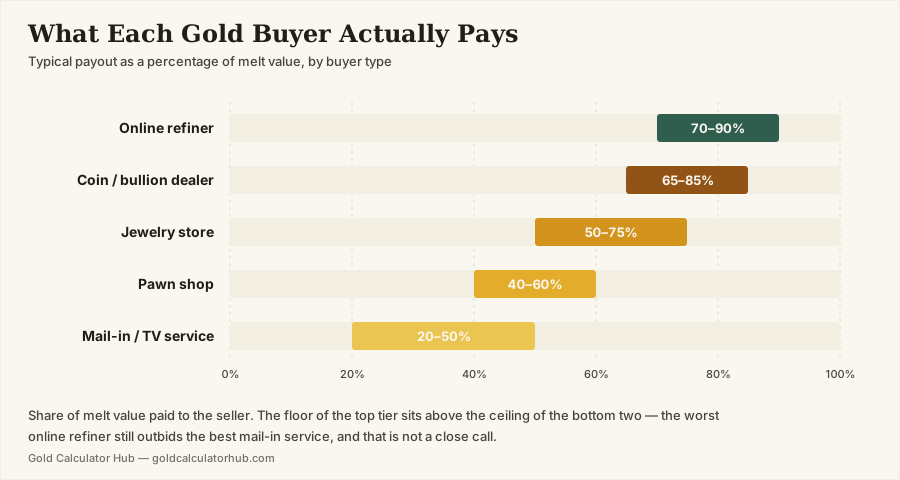
Here's the honest map of how much below spot to sell gold is normal at each type of buyer. "% of melt" is what lands in your hand as a share of your item's metal value; "discount from melt" is the same number stated as the haircut.
| Buyer | Typical % of melt | Discount from melt | What you're paying for |
|---|---|---|---|
| Online gold refiner | 70–90% | 10–30% | Best rates, but you mail your gold and wait |
| Local coin / bullion dealer | 65–85% | 15–35% | Same-day cash, in-person testing |
| Jewelry store | 50–75% | 25–50% | Convenience; most resell to refiners anyway |
| Pawn shop | 40–60% | 40–60% | Speed, and the option to redeem a loan instead |
| Mail-in TV / kiosk services | 20–50% | 50–80% | Marketing spend, mostly |
Read the top row carefully, because it's the benchmark. An efficient buyer working at scale can pay 90% of melt and still make money. That's the ceiling, and it exists — it means every offer below it is a choice about margin, not a hard constraint of the business.
Our page on what percentage do gold buyers pay breaks these ranges down buyer by buyer, and where to sell gold ranks every venue by real payout. The short version for the impatient: online refiners and competitive local dealers are where the money is.
Converting Between "Percent of Melt" and "Percent Below Spot"
Buyers quote in at least four different dialects, and the translation is where a lot of confusion — some of it deliberate — lives.
- "We pay 80% of melt" means you keep 80% of your item's gold value. Straightforward.
- "We pay 20% below melt" means the same thing.
- "We pay $X per gram for 14K" is the most useful form, because it's directly comparable across shops. Divide their per-gram price by the melt value of one gram of 14K to get their real percentage.
- "We pay 95% of spot" is the one to watch. Spot is the price of *pure* gold. If a buyer applies a percentage of the pure-gold price to your 14K item's total weight, that's not generous, that's a category error in their favor — or a deliberate one.
Work an example. Assume gold at $4,400 per troy ounce, which at 31.103 g per ounce is $141.46 per gram. One gram of 14K is 58.33% gold, so it holds $82.51 of metal. A shop offering "$60 per gram for 14K" is therefore paying 60 ÷ 82.51 = 73% of melt, a 27% discount. A shop offering $70 per gram is paying 85%. A shop offering $40 is paying 48%.
That one division — their per-gram offer divided by the per-gram melt value — is the single most useful move in this entire topic. It makes every quote comparable in about ten seconds, and it strips the marketing language off instantly.
Scrap and Bullion Are Two Completely Different Markets
The ranges above describe scrap: jewelry, dental gold, broken chains, unidentifiable lumps. Bullion plays by different rules, and conflating the two produces both false outrage and genuine losses.
A recognizable bullion coin — an American Gold Eagle, a Canadian Maple Leaf, a Krugerrand — isn't feedstock for a refinery. It's inventory a dealer can put in the case and resell within days at a premium over spot. Their margin comes from that resale premium rather than from squeezing your buy price. Consequently it's entirely normal for a competitive dealer to pay 95% of melt or better on common bullion coins, sometimes above melt outright when premiums are strong.
So if you're holding coins, the fair-discount question has a much better answer than it does for jewelry, and anyone quoting you scrap percentages on an Eagle is not making a market — they're making an offer they expect you to accept out of ignorance. The specs and melt figures for every major coin are laid out in melt value of gold coins.
The reverse error is just as costly: taking a collectible coin to a scrap buyer, who will happily pay you 80% of melt for something a numismatic dealer would have paid a multiple of melt for. Know which market your item belongs in before you pick a buyer.
Why the Size of Your Lot Moves the Percentage
The discount you're offered is not a fixed rate. It slides with how much metal you're carrying, and the slope is steeper than most sellers expect.
Fixed costs dominate small transactions. Testing a 4-gram earring takes nearly as long as testing a 200-gram lot, and refining minimums don't care that your contribution is modest. A buyer paying 85% on a large parcel may genuinely only manage 60% on a few grams — the per-gram cost of handling it is simply higher.
Practical consequences:
- Consolidate before selling. One trip with everything beats five trips with pieces, both for your rate and for your time.
- Include the odd bits. Single earrings, broken clasps, bent rings, and dental crowns all count toward lot weight even though none of them is worth a separate visit.
- Don't split across buyers to "test the market." Get quotes on the whole lot from several buyers instead; splitting it lowers your percentage everywhere at once.
- Be realistic under about 10 grams. With roughly $800–900 of metal at recent prices, a small lot will not command a large-lot rate, and chasing one wastes an afternoon.
This is one of the few parts of the spread that's actually within your control, and it's worth several percentage points.
Worked Example: 46 Grams From a Jewelry Box
Concrete numbers, start to finish. Assume gold at $4,400 per troy ounce — $141.46 per gram of pure gold.
The lot, after sorting by karat stamp and weighing on a 0.1 g scale:
- 22.0 g of 14K (58.33% gold) → 22.0 × 0.5833 = 12.83 g pure
- 14.0 g of 18K (75% gold) → 14.0 × 0.75 = 10.50 g pure
- 10.0 g of 10K (41.67% gold) → 10.0 × 0.4167 = 4.17 g pure
Total pure gold: 12.83 + 10.50 + 4.17 = 27.50 g. Melt value: 27.50 × $141.46 = $3,890.
Now apply the spread to see what "how much below spot" means in dollars rather than percentages:
| Buyer | Rate | Offer | You lose vs. melt |
|---|---|---|---|
| Online refiner | 70–90% | $2,723–$3,501 | $389–$1,167 |
| Local dealer | 65–85% | $2,529–$3,307 | $583–$1,361 |
| Jewelry store | 50–75% | $1,945–$2,918 | $973–$1,945 |
| Pawn shop | 40–60% | $1,556–$2,334 | $1,556–$2,334 |
| Mail-in service | 20–50% | $778–$1,945 | $1,945–$3,112 |
The spread between the best plausible offer and the worst is $2,723 on a single jewelry box — more than the entire lot is worth at the bottom of the range. The gold didn't change. The choice of buyer did. Run your own numbers with the scrap gold calculator before you go anywhere.
What an Actual Rip-Off Looks Like
A low percentage isn't automatically dishonest — a pawn shop paying 50% is transparently selling you speed. What makes an offer a rip-off is the technique used to get you there. Watch for these:
- Weighing in pennyweight while quoting per gram. A dwt is 1.555 g, so a per-gram price applied to a dwt weight underpays you by about 36%. Ask which unit the scale is set to.
- Down-karating. Testing a stamped 18K piece and calling it 14K, or lumping everything into "we'll call it all 10K" for convenience. Insist on karat-by-karat sorting.
- A scale you can't see. The display should face you. If it doesn't, that's the whole review.
- Bundling stones in the weight, then paying nothing for them. Gemstones must come off the gold weight or be paid for separately.
- Quoting a percentage of spot applied to gross weight — described above, and always in the house's favor.
- Urgency. "This price is only good today" on a commodity with a continuously published global price is theater.
- Opened mail-in packages with no return option. The FTC's guidance on selling gold jewelry is specific about getting terms in writing before you ship.
The full playbook, including the classics used on inherited lots, lives in cash for gold scams.
How to Get Quotes That Are Actually Comparable
Three quotes are worth more than any amount of research, but only if they're quoted in the same terms. The script:
- Weigh and sort at home first. By karat, on a scale reading 0.1 g. Write it down.
- Compute your melt value before you leave the house, and know it to the dollar.
- Ask each buyer one question: "What's your per-gram buy price for 14K today?" (Substitute your dominant karat.) This forces a comparable number and skips the entire negotiation dance.
- Divide their answer by your per-gram melt figure to get their real percentage. Note it.
- Get the third quote even when the second one is good. The gap between quote two and quote three is frequently larger than people expect.
- Don't accept a bundled "for everything" figure until you've seen it broken down by karat and weight.
Online refiners deserve a specific note: most publish per-gram buy prices openly, which makes them the easiest benchmark in the market even if you ultimately sell locally. Check two of them, and you have a number that any in-person buyer has to beat. The tradeoffs of mailing versus walking in are compared in sell gold online or locally.
Can You Ever Sell Gold At or Above Spot?
Occasionally, in four situations — none of which involve scrap jewelry.
Bullion coins during strong premium periods. When retail demand is hot and mint supply is tight, dealers sometimes bid at or slightly above melt for common coins because they can resell above spot immediately.
Private sales between individuals. Selling a coin directly to another buyer cuts out the dealer entirely, and a fair private price often sits between what a dealer would pay and what one would charge. You're taking on the counterparty risk and the authentication burden yourself, which is exactly why the price is better.
Jewelry worth more as jewelry. A signed designer piece, a period item, or anything with brand or craftsmanship value should never be sold by weight. Consignment or auction can far exceed metal value, at the cost of time and a seller's commission.
Numismatic coins. Rarity is a separate market with separate prices, and melt is irrelevant to it.
For everything else — the tangled chain, the single earring, the class ring nobody wants — melt minus a competitive discount is the honest ceiling, and the goal is simply to keep the discount in the 10–20% range instead of the 50%+ range.
The Number to Walk In With
If you want one target rather than a table: aim for 80% of melt or better on a decent-sized scrap lot, and treat anything under 60% as a signal to leave.
That's a 20% discount from your item's metal value at the target, which fairly compensates a buyer for testing, refining, aggregation, price risk, and margin. Getting there requires almost nothing: know your weight, know your karat, know your melt value, and collect three quotes. The sellers who get 45% aren't victims of a rigged market — they're almost always people who took the first offer.
Coins are a different target: expect 90%+ on recognizable bullion, and get an appraisal before selling anything old by weight.
And one last piece of perspective. The difference between a good and a poor sale is usually a couple of hours of effort, not a special relationship or insider knowledge. On the 46-gram lot above, those hours were worth more than $2,000. On a smaller lot they might be worth $200 — still an excellent hourly rate. Work out your number, make three phone calls, and refuse to be rushed. Nothing about a global commodity price expires this afternoon.
This is general consumer information rather than financial or tax advice; if a sale is large enough to have tax consequences for you, talk to a professional about it first.
Frequently Asked Questions
Can I sell gold at spot price?
Not for scrap jewelry, from any buyer. Spot is the wholesale price of refined, standardized bullion in institutional quantity, and your chain is none of those things — somebody has to test it, refine it, aggregate it, and carry the price risk in between. The realistic best case is 90% of melt from an efficient online refiner. Recognizable bullion coins are the exception: dealers resell them at a premium, so offers at or above melt genuinely happen there.
Is 70% of melt value a fair offer for gold jewelry?
It's acceptable but not good. Seventy percent sits at the bottom of the online-refiner range and the middle of the local-dealer range, so it's a legitimate market price rather than a swindle — but it's roughly ten to fifteen points below what a competitive buyer will pay for a reasonable lot. Before accepting it, get one more quote from an online refiner with published per-gram prices. If the offer is on a small lot of a few grams, 70% is more defensible, since fixed handling costs weigh heavier.
Do gold buyers pay market value?
They pay a discount to market value, and the honest ones say so plainly. The discount funds assay, refining, inventory holding, price-risk hedging, insurance, and margin — real costs that run roughly 10–30% at an efficient operation. What varies wildly is everything above that floor: a pawn shop keeping 50% isn't covering higher costs, it's pricing your convenience and betting you won't shop around. Ask any buyer directly what percentage of melt they're paying; a reluctance to answer is itself informative.
How do I calculate what percentage of spot a buyer is offering?
Divide their per-gram offer by the melt value of one gram of your karat. At an assumed $4,400 per troy ounce, pure gold is $141.46 per gram, so one gram of 14K holds $141.46 × 0.5833 = $82.51 of metal. An offer of $66 per gram is therefore 66 ÷ 82.51 = 80% of melt. Do this for every quote and the marketing language disappears — you're left with one comparable number per buyer, which is all you need.
Where can I sell gold to get the best price?
For scrap, online refiners with published per-gram buy prices generally top the market at 70–90% of melt, followed by competitive local coin and bullion dealers at 65–85%. Jewelry stores, pawn shops, and mail-in services descend from there. For bullion coins, a local dealer usually wins because they resell coins at a premium rather than refining them. Whichever route you pick, the deciding factor is comparison shopping, not venue: three quotes reliably beats one from the theoretically best channel.
Why did a pawn shop offer me half of what my gold is worth?
Because pawn shops sell speed and liquidity, not price. They hand over cash in minutes with no waiting, no shipping, and often the option to redeem the item later if it's a loan rather than a sale — and they price all of that into a 40–60% offer. It's a legitimate product if you need money today. It's a bad trade if you don't. The pawn model in detail, including how to negotiate within it, is covered in how much do pawn shops pay for gold.
Does the discount get smaller if I sell more gold at once?
Yes, noticeably. Testing, handling, paperwork, and refining minimums are largely fixed costs per transaction, so they weigh far more heavily on 5 grams than on 200. A buyer who pays 85% on a substantial parcel may honestly only manage 60% on a handful of earrings. Consolidate everything into one sale — including broken pieces, single earrings, and dental gold — rather than making several small trips, and the percentage moves in your favor without any negotiation at all.
How much should I sell my gold for if it's mixed karats?
Sort it by karat before you go anywhere, weigh each group separately, and compute melt for each. Then target a single percentage of the combined melt total. What you must avoid is a buyer 'simplifying' by pricing the whole lot at the lowest karat present — an 18K piece paid at 10K rates loses you nearly half its value. Ask explicitly for a karat-by-karat breakdown on the quote sheet, and decline any offer that won't show its weights.

Written by Sukie Gao
Sukie Gao holds a master's degree from a business school, where she picked up the markets-and-pricing toolkit she now applies to the consumer gold trade. She created Gold Calculator Hub to give people an independent, data-driven way to find out what their gold is really worth.
Published September 12, 2026