How Much Is an Ounce of Gold Worth? From 1/10 oz to 100 oz
 By Sukie Gao · October 19, 2026
The quick answer to how much is an ounce of gold worth: one troy ounce of pure gold is worth exactly the spot price, which has recently sat somewhere near $4,300–$4,500. The calculator above pulls that price live, so the headline number is already on your screen.
The longer answer is where people lose money. "An ounce of gold" means three different things depending on who says it. To a bullion dealer it is 31.103 grams of fine gold. To someone weighing a chain on a kitchen scale it is 28.350 grams of an alloy that may be little more than half gold. And to anyone actually selling, it is a number that gets multiplied by a buyer's percentage before it becomes cash.
This page walks through all three, using one clean assumption so the arithmetic is checkable: gold at $4,400 per troy ounce, which works out to $141.46 per gram of pure gold. Swap in today's price and every figure below scales in proportion.
Short answer first: an ounce of fine gold is worth spot
Gold is priced in US dollars per troy ounce of pure (fine) metal. That is the unit the LBMA benchmark uses, the unit futures trade in, and the unit behind every "gold hits a record" headline. A troy ounce is 31.103 grams.
So when spot reads $4,400, the statement is precise: 31.103 grams of fine gold is worth $4,400 at wholesale. Not a ring that weighs an ounce, not a coin with "1 oz" printed on it until you check what it contains — the gold itself.
That distinction sounds pedantic until you hold real objects:
- A 1 oz American Buffalo is .9999 fine and contains one troy ounce of gold. Its metal is worth spot.
- A 1 oz American Gold Eagle is 22K. It also contains one troy ounce of gold, but it weighs about 33.93 grams because copper and silver were added for durability. Its metal is *also* worth spot — the extra 2.8 grams of alloy add nothing.
- A 1 oz bar stamped 999.9 is, like the Buffalo, one ounce of gold and worth spot in metal.
The US Mint specifies its bullion coins by gold content precisely so that the "1 oz" on the face means one ounce of gold, whatever the coin weighs on a scale. Jewelry has no such promise. That is the whole reason the rest of this page exists.
The ladder, from a tenth of an ounce to a hundred
Because value is linear in weight, the ladder is just spot multiplied by the quantity. At the assumed $4,400 per troy ounce:
- 1/10 oz (3.11 g): $440
- 1/4 oz (7.78 g): $1,100
- 1/2 oz (15.55 g): $2,200
- 1 oz (31.10 g): $4,400
- 5 oz (155.5 g): $22,000
- 10 oz (311.0 g): $44,000
- 60 oz (1,866 g, about 1.87 kg): $264,000
- 100 oz (3,110 g, about 3.11 kg): $440,000
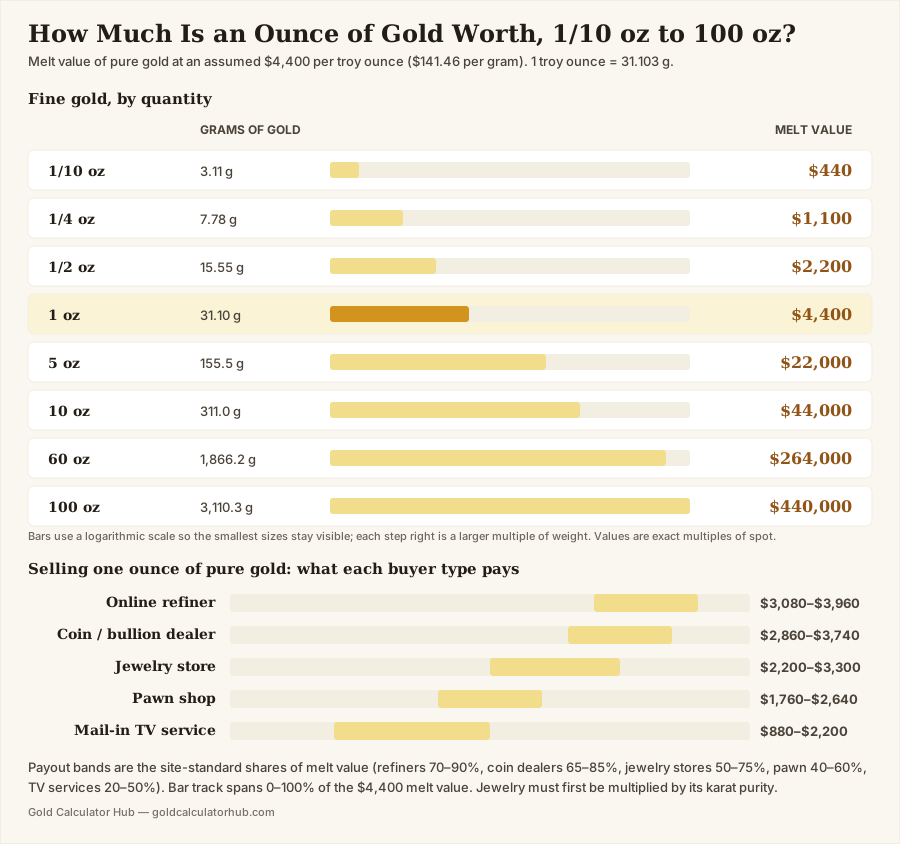
Two things are worth noticing. First, the fractional sizes carry no discount or bonus in melt terms: a quarter ounce is exactly a quarter of the ounce price. Any difference you see when buying small coins is the seller's premium, not the gold.
Second, the gram column answers a question people ask constantly: a 1/4 oz of gold is 7.78 grams (31.103 ÷ 4 = 7.776). If you weigh a quarter of a kitchen ounce instead, you get 7.09 grams — about 9% less metal than the coin actually holds. The troy ounce vs ounce guide covers why the two ounces never merged.
Selling one ounce: what actually lands in your hand
Spot is the price of gold changing hands between large wholesale players. A private seller walking in with one ounce gets a percentage of it, and that percentage depends far more on *who* you sell to than on anything about the gold.
Using the ranges this site applies to every valuation, here is what one ounce and ten ounces of pure gold fetch at $4,400 spot:
| Buyer type | Share of melt | 1 oz pays | 10 oz pays |
|---|---|---|---|
| Online refiner | 70–90% | $3,080–$3,960 | $30,800–$39,600 |
| Local coin or bullion dealer | 65–85% | $2,860–$3,740 | $28,600–$37,400 |
| Jewelry store | 50–75% | $2,200–$3,300 | $22,000–$33,000 |
| Pawn shop | 40–60% | $1,760–$2,640 | $17,600–$26,400 |
| Mail-in TV service | 20–50% | $880–$2,200 | $8,800–$22,000 |
Read the spread between the top and bottom rows: the same ounce can bring $3,960 or $880. Nothing about the metal changed. Only the buyer did.
These bands are built around jewelry and scrap that a buyer has to test and refine. A recognizable bullion coin or a sealed bar is easier to resell as-is, which is why offers on those tend to cluster at the generous end; the how much below spot to sell gold page goes into what a fair discount looks like for each.
The FTC's advice on selling gold is short and correct: know your weight and karat before you go in, get quotes from more than one buyer, and watch the item being weighed.
Why "an ounce" of jewelry is rarely an ounce of gold
Ask how much is an ounce of gold worth while holding a piece of jewelry, and the honest answer is almost always "less than the spot price." Here is the mistake behind most disappointing counter offers. Someone puts a bracelet on a kitchen scale, sees "1.0 oz," looks up spot, and expects around $4,400. Two separate things are wrong.
The scale reads standard ounces of 28.350 g, not troy ounces of 31.103 g. And the bracelet is an alloy. A 14K piece is 58.33% gold; the rest is copper, silver and zinc that the buyer will not pay for.
What a full *troy* ounce of each common karat actually contains, and is worth at $4,400:
| Karat | Gold in the alloy | Fine gold in 1 troy oz of the piece | Melt value |
|---|---|---|---|
| 24K | 99.9% | 31.07 g | $4,395.60 |
| 22K | 91.67% | 28.51 g | $4,033.48 |
| 18K | 75% | 23.33 g | $3,300.00 |
| 14K | 58.33% | 18.14 g | $2,566.52 |
| 10K | 41.67% | 12.96 g | $1,833.48 |
So a troy ounce of 10K jewelry holds well under half an ounce of gold. Put the same ounce through the per-gram route on the how much is a gram of gold worth page and you land on the same numbers; the unit changes, the gold doesn't.
If your piece is stamped with a fineness number instead of a karat, 999, 917 (or 916), 750, 585 and 417 map to the rows above. Plated or gold-filled stamps (GP, HGE, GF, RGP) are a different category entirely and are worth a small fraction of any row in this table.
Worked example: the bracelet that weighs exactly one ounce
Take a 14K yellow-gold bracelet that reads exactly 1.00 oz on a kitchen scale. Gold is at $4,400. Here is the honest valuation, step by step.
- Convert the weight to grams. A kitchen ounce is a standard ounce: 1.00 × 28.350 = 28.35 g.
- Find the pure gold. 28.35 g × 0.5833 = 16.54 g of fine gold.
- Price it. 16.54 g × $141.46 = $2,339 melt value (unrounded: $2,339.26).
- Sanity check in ounces. 16.54 ÷ 31.103 = 0.53 troy oz of gold — so the "ounce of gold" contains a little over half an ounce.
The naive figure of $4,400 overstates this bracelet by about $2,061 — the true value is barely more than half of it. Most of that gap is karat; a smaller part is the ounce mix-up.
Now apply the buyer bands to $2,339.26:
- Online refiner, 70–90%: $1,637–$2,105
- Local coin dealer, 65–85%: $1,521–$1,988
- Jewelry store, 50–75%: $1,170–$1,754
- Pawn shop, 40–60%: $936–$1,404
- Mail-in TV service, 20–50%: $468–$1,170
A seller who walked in expecting $4,400 would read a $1,900 offer as an insult. Measured against the real melt value, it is about 81% — a competitive bid. That reframing is the entire value of doing the math first, and the gold calculator does all four steps if you enter grams and karat.
Coins and bars: when the scale and the gold disagree
Bullion products are the one place "an ounce" is almost always literal, but even there the scale reading and the gold content can disagree.
Modern bullion coins are specified by fine gold content, not gross weight. The 22K coins — the American Gold Eagle and the South African Krugerrand — weigh about 33.93 g for the one-ounce size because the alloy is heavier than the gold it carries. The 24K coins — the Buffalo and the Canadian Maple Leaf — weigh almost exactly 31.1 g. All four contain one troy ounce of gold and have identical melt value.
That matters in two practical ways:
- Don't price a coin by its scale weight. A 1 oz Eagle at 33.93 g × $141.46 would come to roughly $4,800 — about $400 too high, because you would be paying gold prices for copper.
- Older gold coins are not round ounces. A pre-1933 US $20 Double Eagle holds about 0.9676 oz of gold; a British Sovereign about 0.2355 oz. Their melt values are $4,257 and $1,036 at $4,400.
The full coin-by-coin breakdown, with gross weights and fineness, is on the melt value of gold coins page. One caution that applies to every row there: melt is the floor for a coin, not the ceiling. Rare dates and graded coins can be worth far more than their gold, so get an appraisal before selling anything old by weight.
Ten, sixty, a hundred ounces: what changes at size
At 10, 60 or 100 ounces the arithmetic is no harder, but the stakes per percentage point are. On 60 ounces at $4,400, a ten-point difference between two buyers' percentages is $26,400. On 100 ounces, a $100 move in spot shifts the total by $10,000 before anyone has negotiated anything.
Three habits that matter more as the quantity grows:
- Price per ounce, not per lot. Ask every buyer for a per-ounce or per-gram figure and the karat they are assuming, then divide by spot. A percentage is comparable across buyers; a lump sum isn't.
- Get the testing done in front of you. Large lots are worth an XRF reading or an assay. Bars from recognized refiners are simpler to sell than unmarked pours, which a buyer will want to test.
- Think about tax before you sell, not after. The IRS treats gold coins, bars and jewelry as collectibles, with a maximum long-term capital gains rate of 28% (IRS Topic 409). This page is not tax advice — a tax professional can tell you what applies to your situation.
For the unit question in detail — troy versus standard ounces, and per-ounce values by karat — use the gold price per ounce calculator. For a single figure on a specific item, enter its weight and karat in the calculator above and read the result as melt value, then apply the buyer bands. Whatever the size of the lot, how much is an ounce of gold worth to you comes down to three inputs — fine gold content, spot, and the buyer's percentage — and that result is the number to have in your head when the first offer arrives.
Frequently Asked Questions
How much is 1 troy ounce of gold worth in dollars right now?
One troy ounce of pure gold is worth the current spot price, which the calculator above shows live. Recent prices have run near $4,300–$4,500. That figure is for 31.103 grams of fine gold at wholesale. A 1 oz bullion coin or bar carries that much gold, so its metal is worth spot; jewelry weighing an ounce contains less gold and is worth proportionally less. What a buyer pays you is a percentage of spot, not spot itself.
How many grams is a 1/4 oz of gold?
A quarter troy ounce is 7.78 grams (31.103 ÷ 4 = 7.776). That is the gold content of a 1/4 oz bullion coin such as the quarter-ounce Gold Eagle, whose gross weight is a little higher because of its alloy. Be careful with a kitchen or postal scale: a quarter of a standard ounce is only 7.09 grams, about 9% less. At an assumed $4,400 per troy ounce, a quarter ounce of fine gold is worth $1,100 in melt.
How much is a half ounce of gold worth?
A half troy ounce of fine gold (15.55 grams) is worth half the spot price, so $2,200 at an assumed $4,400 per ounce. Selling it, the site's standard buyer ranges suggest $1,540–$1,980 from an online refiner, $1,430–$1,870 from a coin dealer, and $880–$1,320 from a pawn shop. If the half ounce is a piece of jewelry rather than bullion, multiply by its karat purity first — 14K would be about $1,283 in melt.
What is 10 ounces of gold worth?
Ten troy ounces of pure gold — 311 grams — is worth ten times spot, or $44,000 at an assumed $4,400 per ounce. On a sale, the site's standard bands put that at $30,800–$39,600 from an online refiner and $28,600–$37,400 from a local coin dealer, versus $17,600–$26,400 from a pawn shop. At this size the gap between buyers runs into five figures, so collecting several written quotes is worth an afternoon.
How much is 60 ounces of gold worth?
Sixty troy ounces is 1,866 grams, a little under 1.9 kilograms. At an assumed $4,400 per troy ounce that is $264,000 in pure gold. Every $100 move in spot changes the total by $6,000, and every percentage point in a buyer's offer is worth $2,640. At this level, verify purity with an assay or XRF reading, ask for per-ounce pricing in writing, and talk to a tax professional before selling.
What does it cost to buy an ounce of gold?
Buying costs more than spot. Dealers sell bullion coins and bars at spot plus a premium that covers minting, distribution and their margin, and that premium varies by product, size and market conditions — small fractional coins usually carry a higher premium per ounce of gold than a one-ounce bar. The melt value is the part you could get back; the premium is the part you generally can't. Compare the all-in price per ounce of gold content across sellers.
Is a 1 oz gold coin worth more than 1 oz of gold?
For common bullion coins, the coin's value tracks the ounce of gold inside it, plus or minus a modest premium. For collectible coins it can be very different: rare dates, low mintages and graded examples sell to collectors for far more than their metal. The gold content sets a floor, never a ceiling. Before selling any older or unusual coin for melt, have it looked at by a numismatist rather than a scrap buyer.

Written by Sukie Gao
Sukie Gao holds a master's degree from a business school, where she picked up the markets-and-pricing toolkit she now applies to the consumer gold trade. She created Gold Calculator Hub to give people an independent, data-driven way to find out what their gold is really worth.
Published October 19, 2026