10K Gold Price per Gram Today (Live Value)
 By Sukie Gao · August 15, 2026
The 10K gold price per gram is the number most sellers get wrong, and they get it wrong in the same direction every time — too high, usually by more than double. The reason is simple and slightly uncomfortable: 10 karat gold is 41.67% gold. Fewer than forty-two grams in every hundred are the metal you are being paid for. The rest is copper, silver and zinc, and no refiner pays for those. Enter a weight in the calculator above and it applies today's live spot price to that 41.67% fraction, which is the honest starting figure. What follows on this page is everything the calculator cannot tell you: how the per-gram rate is built, what a real chain and a real class ring actually pencil out to, and why a payout that feels insulting is usually just the arithmetic doing its job. We do not buy gold — we are an independent valuation site — so nothing here is written to soften the number or talk you into a sale.
10K is legally gold and mostly not gold
Ten karat means ten parts of twenty-four are gold. Divide it out and you get 0.4167 — 41.67% gold by weight, stamped 417 on pieces that use millesimal fineness instead of karats. That is not a technicality. It means that when you set a 10K ring on a scale and read 6 grams, exactly 2.5 grams of what you are holding is gold and 3.5 grams is base alloy.
10K exists because of a legal floor. In the United States, nothing below 41.67% purity may be marketed as gold at all, so 10K is the cheapest metal a manufacturer can sell under that word. That is the entire commercial logic of the karat: it is the maximum amount of alloy the law permits. Britain, Ireland and Australia set their floor lower at 9K (37.5%), which is why imported or inherited pieces from those markets carry a 375 stamp that no American retailer would use.
There is a genuine upside, and it is not nothing. More alloy means harder metal. A 10K ring resists scratches and holds its shape better than an 18K one, which is why class rings, men's bands, budget bridal sets and anything expected to survive manual work are so often made in it. The trade is deliberate: you buy durability and a lower sticker price, and you accept that the piece carries less than half the gold of a 24K equivalent. Everything on the resale side follows from that single decision made at the factory, years before you started wondering what the piece is worth.
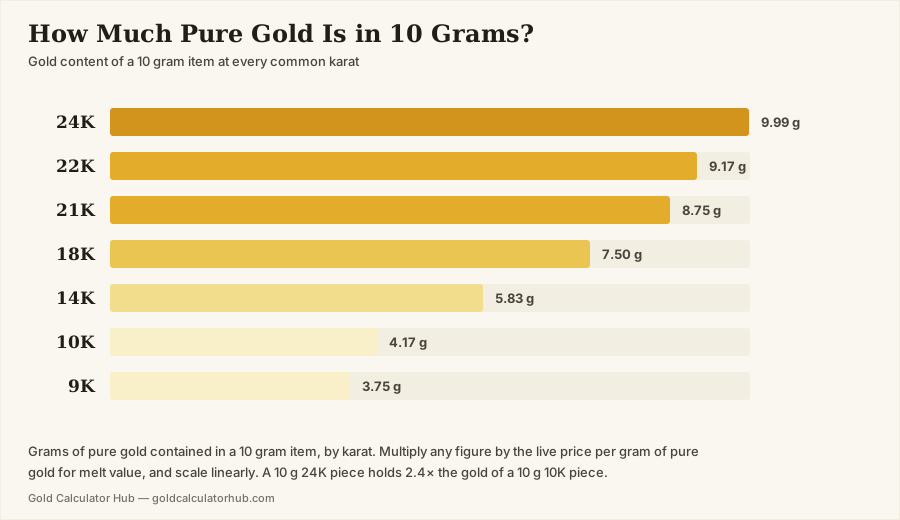
If you want to see how 10K sits against every other purity in one place, our gold purity chart lines up all seven common karats with their stamps and percentages.
Building the per-gram rate from spot
The gold market quotes in troy ounces, not grams, and a troy ounce is 31.103 grams — not the 28.350-gram ounce your bathroom scale thinks in. Every valuation error downstream of that confusion runs about 10%, so start there.
Take a clean assumed spot price of $4,400 per troy ounce, comfortably inside the $4,300–$4,500 range gold has traded near recently. Divide $4,400 by 31.103 and pure gold works out to $141.46 per gram. That is the price of the real thing, 24 karat, no alloy.
Now apply the purity fraction. $141.46 × 0.4167 = $58.95 per gram of 10K.
That is the 10K gold price per gram, and the figure is worth sitting with for a second, because the gap between $141.46 and $58.95 is where the surprise lives. Someone holding a 10K piece and watching gold headlines quoting four thousand dollars an ounce is mentally pricing their jewelry at the pure rate. The actual rate is 41.67% of it.
The other units follow directly from the per-gram number. A pennyweight of 10K — 1.555 grams, the unit a lot of American dealers still quote in — comes to $91.66. A standard avoirdupois ounce of 10K metal is $1,671.19. A full troy ounce of 10K is $1,833.48, which is exactly 41.67% of $4,400, as it has to be.
Spot moves every session, so treat $58.95 as a reference rather than gospel. Gold at $4,300 puts 10K at $57.61 per gram; gold at $4,500 puts it at $60.29. The calculator above reads the live price so the purity math never runs on a stale figure, and how much is a gram of gold worth walks through the pure-gold side of the same calculation.
A 12.5-gram herringbone chain, priced honestly
Numbers in the abstract convince nobody, so take one real object all the way through.
A 10K herringbone chain, stamped 417 at the clasp, weighs 12.5 grams on a jeweler's scale. It cost somewhere in the high hundreds at a mall jewelry counter years ago. What is it worth now?
At our assumed $4,400/oz price, 10K runs $58.95 per gram, so:
12.5 g × $58.95 = $736.86 melt value
Hold that against what the owner probably expected. If you take the same 12.5 grams and price it at the pure gold rate of $141.46 — which is the rate in every headline — you get $1,768.32. The mental figure is two and a half times the real one, and the entire difference is the alloy the manufacturer put in.
It is also worth seeing what that identical chain would be worth in a higher karat, because it explains why karat sorting matters so much. The same 12.5 grams in 14K would melt for $1,031.46. In 18K, $1,326.24. Ten karat is about 71% of 14K's value per gram and a hair under 56% of 18K's. Two chains that look identical across a counter, weigh the same, and differ by nearly six hundred dollars purely because of a three-digit stamp. If you have both in the same drawer, 14K gold price today gives that pile its own number, and the karat gold calculator prices each purity separately.
Now the part that stings. Nobody pays melt. Applying the standard payout bands to that $736.86:
- An online refiner at 70–90% offers roughly $516 to $663
- A local coin or bullion dealer at 65–85% offers roughly $479 to $626
- A jewelry store at 50–75% offers roughly $368 to $553
- A pawn shop at 40–60% offers roughly $295 to $442
So a chain that cost real money at retail, weighs a satisfying amount in the hand, and is genuinely, legally gold, is a three-hundred-dollar conversation at a pawn counter. That is not a scam. That is 41.67% purity meeting a retail markup meeting a buyer's margin, all at once.
The class ring nobody wants to hear about
The single most common 10K item that arrives at a buyer's counter is a high school or college class ring, and it produces more disappointment per transaction than anything else in the category.
Here is why, worked out. A typical men's class ring weighs about 9.4 grams gross. It has a synthetic stone — a spinel or a glass simulant, worth nothing — set in the head, and that stone accounts for roughly 0.6 grams. Buyers deduct stone weight, and they are right to, because a refiner cannot sell it. So the gold-bearing weight is 8.8 grams.
8.8 g × $58.95 = $518.75 melt value
A pawn shop at 40–60% of melt lands between $207 and $311. An online refiner at 70–90% lands between $363 and $467. The ring cost several hundred dollars new, has a name and a graduation year engraved inside it, and the best realistic offer on the open market is under five hundred dollars.
A few things follow from this that are worth knowing before you walk in:
- The engraving is worth nothing to a buyer and everything to nobody else. A personalized ring has effectively no resale market as jewelry, which is why melt value really is the right benchmark here, unlike with designer or antique pieces.
- Weigh it yourself before you go. A $15 scale that reads to 0.1 g removes any ambiguity about the gross figure, and how to weigh gold covers doing it properly.
- Ask how the stone is being deducted. A buyer estimating "about a gram" on a 0.6-gram stone is quietly taking another twenty-three dollars.
- Some rings are 10K on a white gold or steel core. Check the stamp on the inside of the shank, and if it reads GF, GP or HGE, it is not solid gold at all.
None of this makes the ring worthless. It makes it worth what it is worth, which is a very different feeling from what people expect when they walk in holding something they remember paying for.
The offer feels like an insult. It usually isn't.
Three separate reductions stack between the price of gold and the cash in your hand, and because sellers usually only know about one of them, the final number reads as an insult rather than as arithmetic.
Reduction one: purity. You own 41.67% gold. Applied to a headline price, that alone cuts the mental figure by nearly 60% before anyone has made an offer.
Reduction two: the buyer's margin. Refining costs money. So do assay, shipping, insurance, storefront rent and the risk of holding metal while spot moves. Every buyer in the chain takes a cut, and the cut ranges from about 10% at a competitive online refiner to 60% at a pawn shop taking on speed and anonymity as its business model. We break down where each of those percentages comes from on what percentage do gold buyers pay.
Reduction three: the original retail markup, which was never coming back. A mall chain retails at a large multiple of its metal content — design, brand, distribution, sales floor, all of it priced in at purchase. None of that survives resale. The moment a piece leaves the store it is worth its gold and nothing else, and 10K jewelry has less gold in it than any other karat sold in America.
Understanding the stack is what separates a seller who negotiates from one who feels ambushed. The purity reduction is fixed and non-negotiable. The retail markup is sunk and irrecoverable. The buyer's margin is the *only* one of the three you have any influence over — and the spread within it is wide enough to be worth an afternoon. On our 12.5-gram chain, moving from a pawn offer to a competitive refiner is the difference between $295 and $663. Same chain, same day, same metal, and more than double the money.
The leverage is entirely in getting three quotes and asking each buyer for a stated price per gram of 10K rather than a lump sum. A number you can compare is a number you can push on.
Reading the stamp, and knowing when to distrust it
Solid 10K is marked 10K, 10KT, or 417. Occasionally you will find 416, which is the same thing rounded differently. Any of those on a clasp, an inner shank or a pendant bail means the math on this page applies directly.
What you need to catch are the marks that contain a karat number and describe something that is almost entirely base metal:
- 10K GF or 1/20 10K GF — gold-filled. A thin layer of real 10K mechanically bonded over brass, with the gold typically around 5% of total weight and its own low purity on top of that. Worth a small fraction of solid 10K.
- 10K GP, GEP, HGE, RGP — plated or rolled gold plate. Microscopically thin. Effectively zero melt value.
- 925 or Sterling — a silver mark, not a gold one, regardless of how gold-colored the finish is.
The second problem is outright counterfeiting. 10K is not usually the target of sophisticated fakes — there is not enough money in it to justify the effort — but plated brass carrying a crisp 417 stamp turns up constantly in secondhand markets and estate lots, because it is cheap to produce and nobody scrutinizes low-karat pieces closely.
The tests are quick and cheap. A magnet catches steel cores for free. A density check catches many substitutions with nothing but a scale and a glass of water. An acid test kit runs about $20 and resolves karat at home. Most coin and bullion dealers will run a non-destructive XRF scan in seconds, generally at no charge if you are a plausible seller. How to tell real gold from fake walks through them in order of cost and reliability.
One rule that never fails: when the metal and the stamp disagree, believe the metal. A stamp is a claim someone made with a punch, not a certificate anyone verified.
Where to take it, and what to insist on
Low-karat scrap is not a market where charm gets you anywhere, but structure does. A short set of practices that reliably moves the number:
- Sort by karat first. Never let a 10K pile and a 14K pile onto the same scale. At $58.95 against $82.52 per gram, a mixed lot priced at the lower rate donates the difference silently, and it happens through carelessness far more often than through fraud.
- Weigh in grams, yourself, before you leave. State the weight before the buyer does.
- Deduct non-gold weight honestly. Stones, steel clasps, spring bars, enamel and cord all read on a scale and none of them pay.
- Ask for a stated 10K gold price per gram. Not a lump sum for the bag. A lump sum exists to be incomparable.
- Get three quotes minimum. On any lot over a few hundred dollars this is the highest-paid hour of work available to you.
- Compare offers as a percentage of melt. Anything below 50% deserves an explanation, and any buyer who won't state their spot reference and payout percentage in one sentence should be a no.
For mail-in buyers specifically, read the FTC's guidance on selling gold jewelry before you ship anything — it covers what a reputable operation discloses about appraisal, insurance and returning your items if you decline the offer. And if anyone approaches you with an unusually generous story about your low-karat scrap, the CFTC's precious metals fraud advisory is a useful description of how those pitches are built.
Finally, keep some perspective on the effort. A 10K parcel worth $400 does not justify driving to six dealers. Run it through the gold calculator so you know the ceiling, get two or three quotes by phone, and take the best one. Reserve the full shopping-around routine for lots where the spread is worth more than the afternoon — and for those, our 10K gold calculator and where to sell gold rankings will get you there faster.
Frequently Asked Questions
Why is 10K gold worth so much less than 14K?
Because it contains proportionally less gold, and scrap value tracks gold content almost exactly. 10K is 41.67% gold against 14K's 58.33%, so per gram it is worth about 71% as much — roughly $58.95 versus $82.52 with gold at an assumed $4,400 per troy ounce. Nothing about appearance, weight or construction changes that ratio. Two visually identical chains of the same weight can differ by hundreds of dollars purely on the stamp.
Will a pawn shop or jeweler even take 10K jewelry?
Yes, virtually all of them do — 10K is extremely common in the United States and refiners process it routinely. What changes at low karat is the enthusiasm, not the acceptance. Some buyers apply a slightly lower payout percentage to low-karat parcels because refining costs are largely fixed per batch and the gold recovered per gram is smaller. The practical effect is a few percentage points, which is far less than the spread between buyer types.
Does 10K gold tarnish or turn skin green?
It can, and the alloy is why. With 58.33% base metal — mostly copper, plus silver and zinc — a 10K piece has far more reactive material in it than higher karats, so surface tarnish and skin discoloration from copper reacting with sweat and lotions are genuinely more common. This says nothing about authenticity; plenty of real 10K does it. It also has no effect on melt value, since the refiner is recovering the gold regardless of what the surface looks like.
Is it worth selling a small amount of 10K gold?
Do the math before you decide. At roughly $58.95 per gram, a 3-gram 10K ring melts for about $177, and a pawn offer at 40–60% would land somewhere near $71 to $106. That may or may not be worth a trip. Small quantities are usually better accumulated — collect every 10K piece in the house, sort it, weigh it as one lot, and sell it together, since larger parcels attract better percentages and are worth a buyer's time to compete for.
How do I convert a 10K price per gram into a price per pennyweight?
Multiply by 1.555, since one pennyweight is 1.555 grams. At $58.95 per gram, 10K is $91.66 per dwt. Run the conversion in reverse whenever a dealer quotes you in pennyweights: divide their number by 1.555 to get a per-gram figure you can compare against melt. A per-dwt price always looks larger than the equivalent per-gram price, which is exactly why a low offer is harder to spot when it is quoted that way.

Written by Sukie Gao
Sukie Gao holds a master's degree from a business school, where she picked up the markets-and-pricing toolkit she now applies to the consumer gold trade. She created Gold Calculator Hub to give people an independent, data-driven way to find out what their gold is really worth.
Published August 15, 2026