Gold Sovereign Value Calculator: Melt, Premium and Which Ones Are Rare
 By Sukie Gao · November 18, 2026
Quick answer
Every full British Sovereign holds 7.3224 grams of pure gold, struck in 22 carat (916) gold at 7.98805 grams gross. Melt value is 7.3224 times the price per gram of pure gold: at an assumed $143 per gram, about $1,047. A gold sovereign value calculator gives you that floor. Bullion premiums, scarce dates and mints, and the coin's UK Capital Gains Tax exemption usually push its real value above it.
Gold Sovereign Value Calculator: Melt, Premium and Which Ones Are Rare
Live gold price: $3,617.40/ozt · Nov 22, 8:29 PM EST · updates every 10 min
Melt value of 10 g of 14K gold
$678.39
Pure gold content: 5.83 g × $116.30/g
| Where you sell | Typical offer | % of melt |
|---|---|---|
| Online gold refiner | $474.87 – $610.55 | 70–90% |
| Local coin / bullion dealer | $440.95 – $576.63 | 65–85% |
| Jewelry store | $339.20 – $508.79 | 50–75% |
| Pawn shop | $271.36 – $407.03 | 40–60% |
| Mail-in 'cash for gold' TV services | $135.68 – $339.20 | 20–50% |
Ranges reflect typical published buy rates and consumer-test results. We are not a buyer — these numbers exist so you can judge any offer you receive.
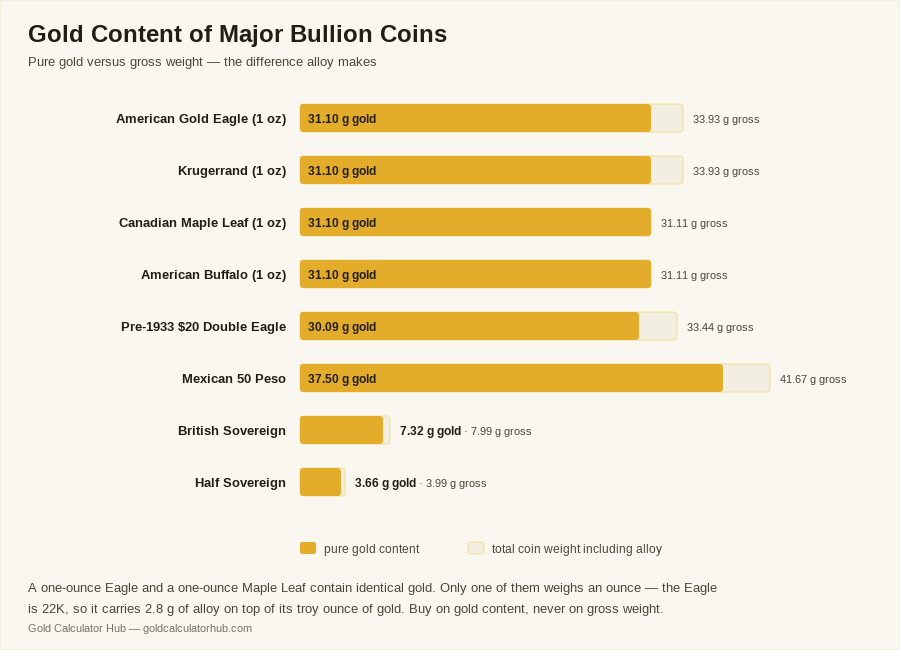
7.3224 grams of pure gold is inside every full British Sovereign, and that one fixed fact is where a gold sovereign value calculator starts. That number has not changed since the Coin Act of 1816. The coin weighs 7.98805 grams gross, is struck in 22 carat gold (916 fineness), and every Sovereign from George III to the present holds exactly the same gold. It is one of the most consistently specified coins in history.
So the melt value is straightforward: 7.3224 grams multiplied by the current price per gram of pure gold. At $143 per gram, that is about $1,047.
What makes Sovereigns interesting rather than merely calculable is everything on top of melt. They carry a bullion premium because they are small, recognisable and instantly tradeable. Certain dates and mints carry a collector premium that dwarfs the metal. And for UK residents they carry a tax status that no bar can match. This page covers the metal first, then the three reasons a Sovereign is usually worth more than its gold.
One clarification before the numbers, because it causes real confusion: the British Sovereign coin is not the same as the "sovereign" used as a weight unit in South Indian jewelry, which is 8 grams of 22K. Similar gold content, entirely different objects.
Sovereign specifications, every denomination
| Coin | Gross weight | Fineness | Pure gold | Melt at $143/g |
|---|---|---|---|---|
| Quarter Sovereign | 1.997 g | 916.7 | 1.831 g | $262 |
| Half Sovereign | 3.994 g | 916.7 | 3.661 g | $524 |
| Full Sovereign | 7.98805 g | 916.7 | 7.3224 g | $1,047 |
| Double Sovereign | 15.976 g | 916.7 | 14.645 g | $2,094 |
| Five Pound (Quintuple) | 39.94 g | 916.7 | 36.612 g | $5,236 |
Every denomination is an exact multiple of the same standard, which is part of why the series is so trusted. The Quarter Sovereign is a modern introduction — first struck in 2009 — while halves, fulls, doubles and fives have been produced across the whole modern era.
Why 22 carat? Because Sovereigns were designed to circulate. Pure gold is soft enough that a coin in a pocket would lose measurable metal to wear within a few years. The 8.33% copper in crown gold makes the coin hard enough to survive decades of handling, which is exactly what happened to millions of them.
Sovereign specifications are published by The Royal Mint, which has struck the coin to the same standard since 1817. The Capital Gains Tax treatment of UK legal tender coins is set out in HMRC's guidance.
The calculation, and a common variant
7.3224 g × price per gram of pure gold = melt value
At $143/g: 7.3224 × 143 = $1,047.
A question that comes up often in a different form: "worth of 12 sovereign of 18K gold jewellery." That is the Indian retail sovereign — 8 grams gross — not the coin. Twelve of those is 96 grams gross. At 18K (75%), that is 72 grams of pure gold: $10,296. At 22K it would be 88 grams: $12,584.
The two "sovereigns" differ by less than a gram in gross weight, which is precisely why the confusion persists and why it is worth being explicit about which one is meant. If someone is discussing jewelry, they mean the 8-gram unit. If someone is discussing coins, they mean the 7.98805-gram coin.
Bullion premium: why Sovereigns beat melt
Common-date Sovereigns typically trade at 3–8% over melt when buying and sell back at melt to a few percent under, which is a tighter spread than most small gold products.
Three reasons.
Recognisability. A Sovereign is instantly identifiable by anyone in the trade, worldwide. No assay needed, which removes cost from every transaction.
Divisibility. At roughly $1,000 each, Sovereigns let you sell part of a holding without breaking a large bar. This is a genuine practical advantage that people underrate until they need it.
Depth of market. Enormous numbers were minted — hundreds of millions across the series — so there is always a bid. Illiquidity is what makes obscure bullion products expensive to exit.
Compare this with a one-tenth-ounce modern bullion coin, which can carry a 10%+ premium because the minting cost per unit of gold is high. The Sovereign occupies a sweet spot: small enough to be divisible, common enough to be cheap.
UK tax status: the reason Sovereigns dominate British holdings
For UK residents, Sovereigns have an advantage no bar can replicate.
They are legal tender in the UK, with a nominal face value of one pound. Because of that, gains on British Sovereigns minted in 1837 or later are exempt from Capital Gains Tax for UK taxpayers, and the same applies to Britannias (HMRC Capital Gains Manual, CG78305). Earlier Sovereigns, including the George III and George IV dates, are not legal tender, so HMRC treats them as chattels: a gain is exempt only if the sale price is within the chattels limit.
A kilo bar, a Krugerrand and a Maple Leaf are all subject to CGT on gains above the annual exemption. A Sovereign dated 1837 or later is not.
Investment gold is also VAT-exempt across the UK and EU, which applies to bars and coins alike provided they meet the purity and form criteria — so that is not a Sovereign-specific advantage, but it matters when comparing gold with other collectibles.
The practical consequence is that UK investors holding meaningful amounts of physical gold overwhelmingly favour Sovereigns and Britannias, accepting a slightly higher premium per gram in exchange for the tax treatment. Whether that trade is worth it depends on the size of the expected gain, and it is a question for a tax adviser rather than a calculator. This is general information, not tax advice.
When the date matters more than the metal
Most Sovereigns are common and trade on bullion terms. A minority are genuinely rare, and the premiums are large.
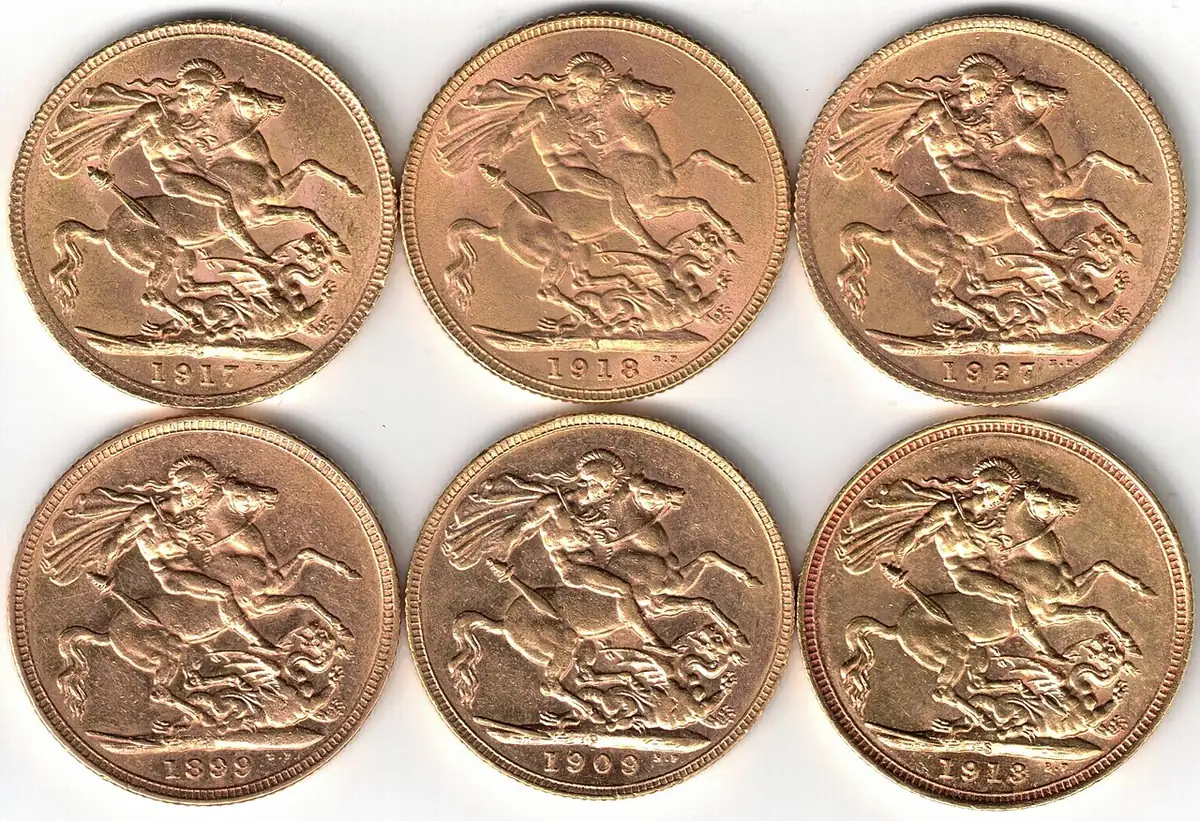
Branch mints. Sovereigns were struck in London and at branch mints in Sydney (S), Melbourne (M), Perth (P), Ottawa (C), Bombay (I) and Pretoria (SA). The mint mark is small — usually on the ground above the date on St George reverses, or below the shield on shield-back types. Some branch-mint years had tiny mintages.
Key dates. The 1819 George III, the 1841 Victoria, the 1917 London, and various low-mintage Ottawa and Bombay issues command multiples of melt. Some are worth tens of thousands.
Type rarities. Shield-back reverses, early Victoria "Young Head" types, and Edward VII proofs all trade above bullion.
Condition. An uncirculated example of even a common date carries a premium over a worn one.
The practical rule: before selling any Sovereign for melt, note the date, the monarch, and any mint mark, and search them. It takes two minutes. Selling an 1841 Sovereign at bullion price would be a genuinely expensive mistake, and a bullion dealer buying by weight has no obligation to mention it.
Identifying and checking a Sovereign
Counterfeit Sovereigns exist, and there are two distinct kinds.
Contemporary forgeries of base metal or low-grade gold, made to deceive. These fail on weight and dimensions.
"Full weight" fakes made from correct-purity gold, produced historically in the Middle East and Italy to satisfy demand where genuine coins were scarce. These contain the right gold and are worth their metal, but not the coin premium.
Four checks, none requiring equipment beyond a scale and calipers.
Weight: 7.98805 g. A genuine circulated Sovereign may be a few hundredths light from wear; anything below about 7.90 g is suspect.
Diameter: 22.05 mm. Thickness: 1.52 mm.
Magnetism: none. A Sovereign that responds to a magnet is not gold.
Design detail: genuine coins have crisp, well-defined lettering and a sharp rim. Cast fakes show soft detail and sometimes a seam.
For anything valuable, a dealer's specific gravity test or XRF reading settles it in seconds.
Half Sovereigns and fractional economics
A Half Sovereign contains 3.661 g of pure gold — $524 at $143/g — and typically carries a higher percentage premium than a full Sovereign, often 6–12%.
That is the standard fractional-bullion pattern: minting a small coin costs nearly as much as minting a large one, and the cost is spread over less gold. The premium per gram therefore rises as the coin shrinks.
When fractionals still make sense: when you want the ability to sell in smaller increments, when you are gifting, or when the collector market for a particular half is stronger than for the equivalent full.
When they do not: when accumulating gold efficiently. Full Sovereigns, or larger coins and bars, deliver more metal per dollar.
Quarter Sovereigns, being modern and small, carry the highest premiums of the series and are bought largely as gifts rather than as an efficient store of value.
Selling a Sovereign: where and for how much
Sovereigns should never go to a scrap gold buyer, and this is the single most important practical point on the page.
A cash-for-gold counter pays a percentage of melt — perhaps 60% — for jewelry, and will happily apply similar logic to a coin if you let them. A coin dealer pays melt to slightly above for a common Sovereign, because they can resell it as a coin without refining anything.
| Buyer | Expected outcome |
|---|---|
| Coin / bullion dealer | Melt to a few percent above; the correct channel |
| Online bullion dealer | Published buy price, often the best and fully transparent |
| Auction | Right for genuinely rare dates; fees of 10–25% apply |
| Jewelry store | Variable; may treat it as scrap |
| Pawn shop | 40–60% of melt; badly wrong for a coin |
| Cash-for-gold / mail-in | Worst possible choice |
Most online bullion dealers publish live buy prices for Sovereigns. Checking two or three takes five minutes and gives you a firm number to compare any local offer against — which is a far stronger position than walking in and asking what they will give you.
Sovereigns versus other bullion coins
| Coin | Pure gold | Fineness | Notes |
|---|---|---|---|
| Sovereign | 7.322 g | 916.7 | UK CGT-exempt if dated 1837 or later; highly divisible |
| Krugerrand (1 oz) | 31.103 g | 916.7 | Same alloy, four times the gold |
| Gold Eagle (1 oz) | 31.103 g | 916.7 | US legal tender; 33.93 g gross |
| Maple Leaf (1 oz) | 31.103 g | 999.9 | Purer, softer, marks easily |
| Britannia (1 oz) | 31.103 g | 999.9 | UK CGT-exempt like the Sovereign |
The Sovereign's distinguishing features are its small size and its UK tax status. Per gram of gold it costs slightly more than a one-ounce coin, which is the price of divisibility.
One detail worth noticing in that table: the Sovereign, Krugerrand and Eagle are all 916.7 fineness — the same 22 carat crown gold standard, adopted independently for the same reason, which is durability in circulation. The Maple Leaf and Britannia at 999.9 are purer and correspondingly softer; collectors handle them carefully because they scratch and mark far more easily.
A checklist before you sell
- Weigh it. 7.98805 g for a full Sovereign. Note any large deviation.
- Check the diameter — 22.05 mm — and confirm it is not magnetic.
- Record the date, monarch and mint mark. Search them before doing anything else.
- Assess condition. Uncirculated examples carry a premium even on common dates.
- Calculate melt — 7.3224 g × the live price per gram — as your floor.
- Get buy prices from two or three online bullion dealers so you have a benchmark.
- Take it to a coin dealer, not a gold buyer. This one step is worth more than everything above it.
- If the date is scarce, consider auction and factor in seller's fees of 10–25%.
Frequently Asked Questions
Are gold Sovereigns exempt from Capital Gains Tax?
For UK taxpayers, yes for Sovereigns minted in 1837 or later: they are UK legal tender with a nominal face value of one pound, and HMRC treats gains on them as exempt sterling currency (CG78305). Britannias share this status. Pre-1837 Sovereigns are not legal tender and fall under the chattels rules instead. Krugerrands, Maple Leafs and gold bars do not — gains on those are chargeable above the annual exemption. This is general information rather than tax advice; confirm your own position with a tax adviser.
How can I tell if a gold Sovereign is fake?
Start with weight and dimensions: 7.98805 g, 22.05 mm diameter, 1.52 mm thick. Circulated coins may be a few hundredths light from wear, but anything below about 7.90 g is suspect. Check it is not magnetic. Look at the detail — genuine coins have crisp lettering and a sharp rim, while cast fakes show soft detail and sometimes a seam. Note that some historical fakes were made from correct-purity gold and are worth their metal but not the coin premium.
Which gold Sovereigns are worth more than melt value?
Key dates and scarce branch-mint issues. The 1819 George III, the 1841 Victoria, the 1917 London issue and various low-mintage Ottawa and Bombay coins command large multiples of melt. Shield-back reverses and early Victoria Young Head types trade above bullion, as do uncirculated examples of otherwise common dates. Always note the date, monarch and mint mark and search them before selling — the mint mark is small, usually above the date on St George reverses.

Written by Sukie Gao
Sukie Gao holds a master's degree from a business school, where she picked up the markets-and-pricing toolkit she now applies to the consumer gold trade. She created Gold Calculator Hub to give people an independent, data-driven way to find out what their gold is really worth.
Published November 18, 2026