Gold Watch Value Calculator: Cases, Bands and the Movement Problem
 By Sukie Gao · Updated November 14, 2026
Quick answer
Weigh only the gold. Subtract the movement, crystal, dial, spring bars and any steel parts, then multiply the gold weight by its purity (75% for 18K, 58.33% for 14K) and by the pure gold price. At an assumed $143 per gram, a 22 g 18K case melts to about $2,360. Before trusting any gold watch value calculator, check for a brand: a gold Rolex, Patek, Omega or Cartier is worth multiples of melt.
Gold Watch Value Calculator: Cases, Bands and the Movement Problem
Live gold price: $3,887.60/ozt · Nov 14, 3:21 PM EST · updates every 10 min
Melt value of 10 g of 14K gold
$729.06
Pure gold content: 5.83 g × $124.99/g
| Where you sell | Typical offer | % of melt |
|---|---|---|
| Online gold refiner | $510.34 – $656.16 | 70–90% |
| Local coin / bullion dealer | $473.89 – $619.70 | 65–85% |
| Jewelry store | $364.53 – $546.80 | 50–75% |
| Pawn shop | $291.62 – $437.44 | 40–60% |
| Mail-in 'cash for gold' TV services | $145.81 – $364.53 | 20–50% |
Ranges reflect typical published buy rates and consumer-test results. We are not a buyer — these numbers exist so you can judge any offer you receive.
A gold watch value calculator has to answer a harder question than most, because a gold watch is the least gold-like gold item people own. The case may be 18K. The band may be 18K, or steel, or gold-filled. The movement, crystal, dial, hands, crown stem, spring bars and case back gasket are none of those things and weigh a surprising amount. Put the whole watch on a scale, apply the gold price, and you can overstate the metal by two or three times.
So the sequence here is subtraction before multiplication. Work out what is actually gold, weigh only that, and then use the calculator above.
And there is a second question that matters more often with watches than with any other category: is this worth vastly more as a watch than as metal? For a great many gold watches the answer is yes, and the gap is not subtle. A gold Rolex, Patek, Omega or Cartier is worth multiples of its melt value, and the number of such watches that have been scrapped by people who did not check is genuinely painful to think about. This page covers the metal honestly, and then tells you when to stop.
Stop here first: does this watch have a name?
Before any weighing, look at the dial and the case back for a brand.
If it says Rolex, Patek Philippe, Audemars Piguet, Vacheron Constantin, Cartier, Omega, Jaeger-LeCoultre, IWC, Breguet, Blancpain, Longines, Universal Genève, Zenith, Heuer, Movado, Hamilton or Gruen — stop. Do not scrap it. Even a non-working example of many of these is worth far more than its gold.
A solid 18K Rolex Day-Date contains perhaps $8,000–$12,000 of gold at current prices and sells as a watch for many times that. A 1960s Omega Constellation in 18K holds a few thousand dollars of metal and is a collectible object. Vintage Cartier tanks, Universal Genève chronographs and early Heuers all trade on the watch market at levels that make their metal content irrelevant.
Even unbranded or minor-brand gold watches sometimes carry value as objects — Art Deco cases, unusual complications, or original boxes and papers.
The check costs nothing: search the brand and any reference number on the case back. If the watch has a name that returns results, take it to a watch specialist rather than a gold buyer. Melting is irreversible and gold buyers are under no obligation to tell you what you are giving up.
What is actually gold on a watch
Assuming you have established it is a scrap candidate, here is the anatomy.
Usually gold: the case (front and back, if solid), the bezel, the lugs, sometimes the crown, and the band if it is a matching gold bracelet.
Usually not gold: the movement (brass, steel, jewels), the crystal (glass, acrylic or sapphire), the dial, the hands, the case back if it is a steel back on a gold case — very common — the spring bars, the crown stem, and any gaskets.
Frequently gold-filled or plated rather than solid: watch cases are among the most commonly gold-filled items ever made. Mid-century American watches especially. Look for GF, 10K RGP, 14K GF, 20 MICRONS, or PLAQUE OR G20 on the case back. Any of those means a bonded or plated layer, not solid gold.
The band is a separate question from the case. A solid gold case on a steel or gold-filled band is extremely common, and vice versa is rare. Weigh and mark them separately.
Case markings such as GF, RGP and HGE are regulated descriptions in the US under the FTC Jewelry Guides, which define the minimum gold content each abbreviation may claim.
Getting the case weight without the movement
This is the practical crux, and there are three levels of effort.
Best: have a watchmaker remove the movement. They open the case back, lift the movement out, and weigh the case alone. Many will do it for a small fee or free if you are selling to them. This gives an exact number.
Good: weigh the whole watch, then subtract a movement estimate. A typical mechanical wristwatch movement weighs 8–15 g; a quartz movement 3–6 g. A crystal adds 1–3 g, a dial 1–2 g. So a complete 18K dress watch weighing 60 g might carry 40–45 g of gold once everything non-gold is removed.
Rough: assume the case is 55–70% of total watch weight for a solid-gold-case watch on a gold band, and less if the band is steel.
Whatever method you use, the direction of error should be downward. Assume less gold. A refiner will weigh the case after removing everything, and if your expectation was built on gross weight you will be disappointed by a number that is actually correct.
The calculation with realistic watch figures
At a pure gold price of $143 per gram:
| Item | Gold weight | Karat | Pure gold | Melt |
|---|---|---|---|---|
| 18K dress watch case only | 22 g | 18K | 16.5 g | $2,360 |
| 18K case + matching band | 68 g | 18K | 51 g | $7,293 |
| 14K case only, mid-century | 16 g | 14K | 9.33 g | $1,334 |
| 18K watch band alone | 46 g | 18K | 34.5 g | $4,934 |
| 124 g 18K band (heavy) | 124 g | 18K | 93 g | $13,299 |
| Gold-filled case, 14K GF | 30 g gross | — | ~0.9 g | $129 |
The last two rows carry the lesson. A heavy 18K band is a serious asset — 124 grams of 18K holds over $13,000 of gold, which is why gold watch bands are stolen and scrapped so routinely. And a gold-filled case of similar apparent substance holds about a hundred dollars of recoverable metal. The stamp is the difference.
Reading the case back
Watch case marks are usually on the outside or inside of the case back, and they are informative.
Solid gold: 18K, 750, 14K, 585, 9K, 375, sometimes with an assay mark. Swiss cases often carry a helvetia head or a small key mark; British cases carry a full hallmark with assay office and date letter, which dates the watch precisely.
Gold filled: "14K GOLD FILLED," "1/20 14K," "GF," or a maker's designation like Wadsworth, Star, or Keystone with a warranty period ("guaranteed 20 years").
Rolled gold plate: "RGP," often with a fraction.
Electroplate: "20 MICRONS," "PLAQUE OR G20," "HGE," or simply "GOLD PLATED." The micron numbers indicate plating thickness and are common on Swiss and French watches.
Steel back on gold case: the back will say STAINLESS STEEL BACK or ACIER while the case is marked 18K. This is a very common combination and means the back does not count toward gold weight.
A British hallmark is a particular gift: it dates the case to a specific year, which both confirms purity and helps establish whether the watch is collectible.
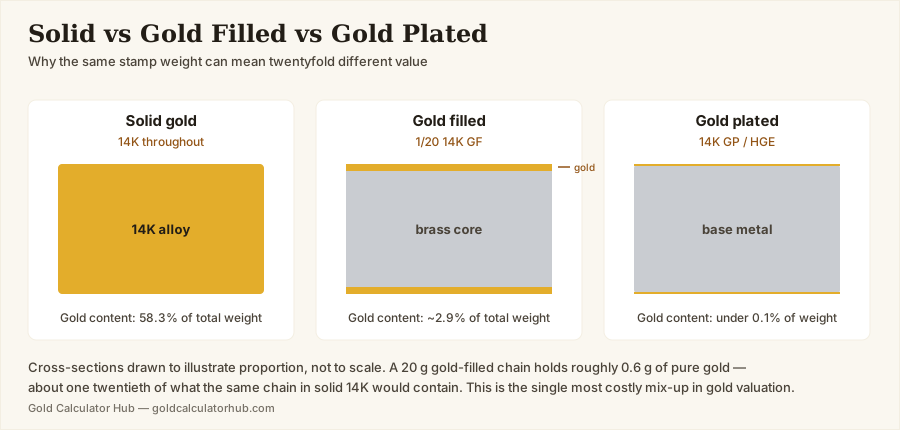
Gold-filled watch cases: what they are actually worth
Because so many mid-century watches are gold filled, this deserves its own treatment.
A gold-filled case has a base metal core with a bonded gold layer, typically specified as a fraction — "1/20 14K GF" means the gold is one twentieth of the case's weight and is 14 karat. On a 30 g case that is 1.5 g of 14K, containing about 0.9 g of pure gold: roughly $129 at $143 per gram.
Two consequences follow.
Refiners generally will not buy small quantities of gold-filled. Recovery cost exceeds yield below a substantial volume. Some specialist buyers take it by the kilo at a low per-pound rate.
The watch is often worth more than the case. A 1950s gold-filled Hamilton, Elgin or Bulova in working order sells to collectors for more than its scrap value, sometimes considerably more. Gold-filled cases from that era were made to a high standard and wear well.
So for gold-filled watches, the scrap route is usually the worst one. Sell the watch as a watch.
Watch bands: the underrated asset
A solid gold watch band is often worth more than the watch head attached to it, and it is the part most likely to be overlooked.
A heavy 18K Oyster-style or brick-link band can run 40–70 g. President-style bands on gold Rolexes run higher still. At 18K, every 10 grams is about $1,073 of gold, so the numbers get large quickly.
Three checks before you scrap a band.
Is it branded? A genuine Rolex, Cartier or Omega band is worth substantially more than melt to collectors and to people restoring watches. Look for signed clasps and stamped end links.
Is it solid or hollow-link? Many gold bands use hollow links to reduce weight and cost. Weight tells you.
Is it gold-filled? Bands are commonly GF even when the case is solid. Check the clasp underside for marks.
If you are scrapping a watch and keeping nothing, weigh the band separately — it may be most of the value.
Pocket watches are a different calculation
Pocket watch cases are larger and heavier than wristwatch cases, so the gold weights are bigger — but the collectible premium is also more common.
A solid 18K hunter case can weigh 40–70 g, which at 18K is $4,300–$7,500 of gold. A 14K open-face case runs 25–45 g.
But American pocket watches were overwhelmingly gold filled, and often superbly so: Keystone, Fahys, Dueber and others made 20- and 25-year guaranteed cases that look and wear like solid gold. The case will be marked accordingly.
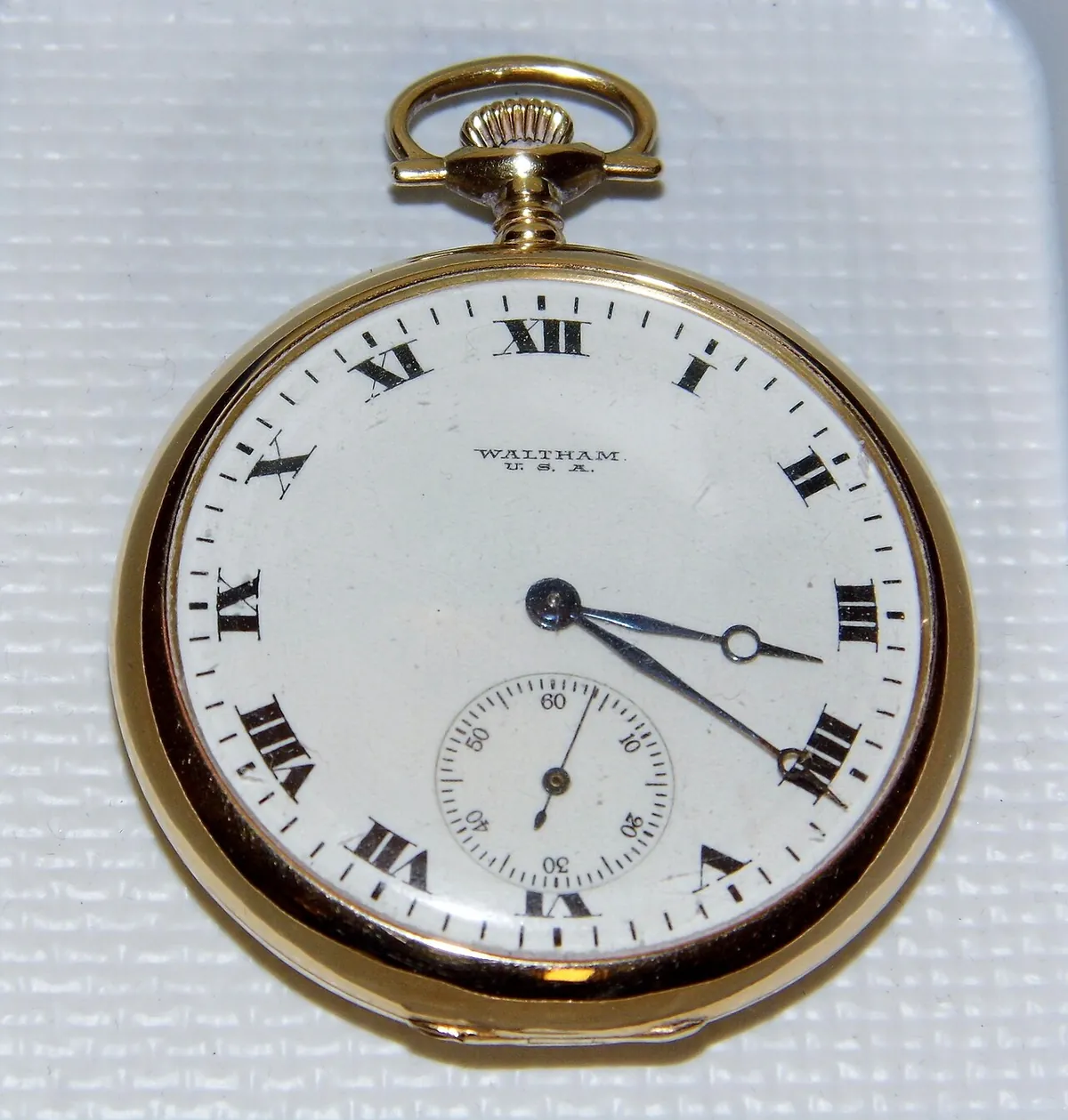
Movements matter enormously here in a way they do not for wristwatches. High-grade American railroad movements — Hamilton 992B, Illinois Bunn Special, Waltham Vanguard, Elgin B.W. Raymond — are collected independently of their cases, and a fine movement in a gold-filled case is worth far more as a watch than the case is as scrap.
For any pocket watch, get the movement identified before touching the case.
What buyers pay for gold watch cases
| Buyer | Share of melt | Notes |
|---|---|---|
| Online refiner | 70–90% | Will weigh the case after movement removal |
| Coin / bullion dealer | 65–85% | Some decline watch cases entirely |
| Jewelry store | 50–75% | Often the only local option |
| Pawn shop | 40–60% | Will value the watch, not just the gold, if branded |
| Watch specialist | Often far above melt | The right buyer for anything branded |
The last row is the important one and does not belong on the same scale as the others, because a watch specialist is buying a different thing. For a branded or interesting watch, their offer is not a percentage of melt at all — it is a market price for a watch, which may be five or fifty times the metal.
For a genuinely anonymous solid gold case with a dead movement and no brand, the refiner route is correct and 70–90% is the fair band.
When the movement is worth keeping
Even on a watch you have decided to scrap, the movement is sometimes separately saleable.
High-grade Swiss movements — Omega calibres, Zenith, Longines, Jaeger — have a market among restorers, as do American railroad-grade pocket watch movements. A working movement pulled from a scrapped case can fetch anywhere from tens to several hundred dollars.
Dials in good condition are also saleable, particularly for brands where original dials are scarce.
The practical approach when scrapping: ask the buyer whether they want the movement and dial, or whether you can keep them. A refiner has no use for either and will often hand them back. Selling them separately on a watch parts market takes effort, but on a decent Swiss movement it can add more than the difference between two gold quotes.
A worked example, start to finish
An 18K gold watch band, weighed at 124 grams, with no brand markings.
Step 1 — check for a brand. Nothing on the clasp or end links. It is genuinely anonymous.
Step 2 — confirm the mark. 750 stamped on the clasp underside. Solid 18K.
Step 3 — check for hollow links. 124 g across a full band is consistent with solid construction; hollow would run considerably lighter.
Step 4 — subtract non-gold. Spring bars and any steel pins: call it 2 g. Gold weight 122 g.
Step 5 — compute gold content. 122 × 0.75 = 91.5 g of pure gold.
Step 6 — compute melt. 91.5 × $143 = $13,085.
Step 7 — realistic payouts. Refiner at 85%: $11,122. Jewelry store at 65%: $8,505. Pawn shop at 50%: $6,543.
The spread between best and worst here is $4,579, on one band, in one afternoon. That is the entire argument for treating the quote-gathering step as the important one.
The checklist
- Look for a brand on the dial and case back. If there is one, stop and research before anything else.
- Read the case back marks. 18K/750/14K/585 means solid. GF, RGP, HGE, MICRONS or PLAQUE means a layer.
- Check whether the case back is steel on a gold case — very common.
- Assess the band separately. It may be most of the value, and may not match the case.
- Get the movement removed by a watchmaker, or subtract 8–15 g for mechanical, 3–6 g for quartz.
- Weigh only the gold, in grams, on a 0.1 g scale.
- Calculate melt with the tool above.
- Ask whether the movement and dial are separately saleable.
- Get quotes, and take anything branded to a watch specialist rather than a gold buyer.
Frequently Asked Questions
How much is an 18K gold watch worth?
For metal alone: weigh only the gold parts — case and band, not the movement, crystal, dial or steel case back — multiply by 0.75, then by the current price per gram of pure gold. A 22 g 18K case holds 16.5 g of pure gold, about $2,360 at $143 per gram. But if the watch carries a recognised brand, the metal figure is beside the point: a gold Rolex, Omega, Cartier or Patek sells as a watch for many times its melt value.
Does the watch movement count toward gold weight?
No. Movements are brass, steel and synthetic jewels — no gold, and they weigh a lot: 8–15 g for a mechanical, 3–6 g for a quartz. The crystal, dial, hands and spring bars are likewise not gold. Weighing a complete watch and applying the gold price can overstate the metal by two to three times. Have a watchmaker remove the movement, or subtract a conservative estimate.
What does 20 microns mean on a watch case?
It is a gold plating thickness specification: 20 microns of gold electroplated onto a base metal case. Common on Swiss and French watches, sometimes marked "PLAQUE OR G20." It is a thicker and more durable plating than typical costume plating, but it is still plating — the recoverable gold value is negligible, usually under a few dollars. A case marked this way is not solid gold regardless of how substantial it looks.
Is the case back on a gold watch also gold?
Often not. A solid gold case with a stainless steel back is an extremely common construction, because the back takes wear and sweat and steel handles both better. The back will normally be marked STAINLESS STEEL BACK, ACIER, or similar, while the case itself is marked 18K or 750. Weigh the back separately and exclude it, or you will overstate the gold by several grams.

Written by Sukie Gao
Sukie Gao holds a master's degree from a business school, where she picked up the markets-and-pricing toolkit she now applies to the consumer gold trade. She created Gold Calculator Hub to give people an independent, data-driven way to find out what their gold is really worth.
Published October 29, 2026 · Updated November 14, 2026