Gold Pawn Loan Calculator: Loan Amount, Charges and Payoff
 By Sukie Gao · November 16, 2026
Quick answer
A pawnbroker lends a share of your gold's melt value, charges a monthly fee capped by state law, and returns the piece when you repay both by the ticket date. Illustratively, 10 grams of 14K at an assumed $4,000 per troy ounce holds $750.14 of gold; a 50% loan is $375.07, and at 10% a month you would pay $487.59 to redeem it after three months. Enter your own offer and rate in the gold pawn loan calculator, since state caps differ widely.
Gold pawn loan calculator
Live gold price: $3,617.40/ozt · updates every 10 min
Melt value
$678.39
gold content at spot
Loan you may be offered
$339.20
50% of melt
Interest + fees
$101.76
120% a year, simple
To get it back
$440.95
after 3 month(s)
The loan share and monthly charge are example inputs, not a quote. Pawn rates are set by state law and differ widely; ask the shop for the written finance charge and APR before you sign.
How much will a pawnbroker lend on your gold, and what will it cost to get it back? A gold pawn loan calculator estimates three numbers: how much a pawnbroker may lend against your gold, what the charges add up to, and what you must pay to get the piece back. An illustrative example: 10 grams of 14K gold at an assumed $4,000 per troy ounce holds $750.14 of gold. A loan at 50% of that is $375.07. At 10% a month for 3 months the charges are $112.52, so redeeming it costs $487.59.
Those inputs are the tool's starting values, not typical rates. Change them to match the offer in front of you. The loan share is whatever the shop offers, and the monthly charge is capped by your state's pawn law, which varies a great deal. This page is about borrowing against gold you intend to keep. If you want to sell instead, the pages on how much pawn shops pay for gold and the pawn shop gold calculator cover outright sale offers.
Below: how a pawn loan runs from pledge to redemption or forfeiture, what the loan is based on, what it costs in two states whose rules we read at the source, the payoff math step by step, the pawn ticket, pawning versus selling, and a counter checklist. This is educational arithmetic, not lending advice.
How a gold pawn loan works, start to finish
A pawn loan is a loan secured by an object instead of by your credit. You hand the pawnbroker a piece of gold, the shop hands you cash and a pawn ticket, and the shop stores the piece. You still have the right to get it back. To do so you repay the amount you borrowed plus the pawn charges by the date on the ticket.
Federal disclosure rules describe the deal in exactly those terms. The official interpretation of Regulation Z (the rule that carries out the Truth in Lending Act) says that when a consumer pledges an item to a pawnbroker "in return for a sum of money and retains the right to redeem the item for a greater sum (the redemption price) within a specified period of time, disclosures are required" (12 CFR 1026, comment 17(c)(1)-18, CFPB, read November 8, 2026). The gap between the cash you received and the redemption price is the finance charge.
What happens next is set by state law, so the details below come from one state whose statute we read in full, Florida's section 539.001 (read November 8, 2026):
- Term. The pawn transaction form must show a maturity date 30 days after the pawn.
- Grace period. If you have not redeemed by maturity, the pawnbroker must hold the goods for at least 30 more days.
- Forfeiture. Goods not redeemed within that period are "automatically forfeited to the pawnbroker" and title passes to the shop with no further notice.
- No obligation to pay. "A pledgor has no obligation to redeem pledged goods or make any payment on a pawn." The shop may not make an agreement that makes you personally liable, and its only recourse is the pledged goods themselves.
- Extensions. The default date can be extended by mutual agreement, in writing, with no limit on the number of extensions.
Under Florida's law, then, the worst outcome is losing the piece; the shop cannot chase you for the balance. Other states set their own terms, so check your state's pawn statute before relying on this.
What the loan amount is based on
The shop lends against what it could get for the piece if you never return. For plain gold jewelry that is mostly the gold content, so the starting point is the melt value: weight in grams × purity × the price of a gram of pure gold. At an assumed $4,000 per troy ounce, pure gold is $128.60 a gram (4,000 ÷ 31.1034768). The illustrative 10 grams of 14K (58.33% gold) therefore holds 10 × 0.5833 × $128.60 = $750.14 of gold.
The loan is a fraction of that. The tool starts at 50% of melt because it is easy to reason about, not because it is a standard. A loan offer for the same item usually comes in below what the same shop would pay to buy it outright, and our selling guides put outright pawn-shop purchases at 40–60% of melt. Treat 50% as an optimistic example and try 30% or 40% in the calculator to see the lower end.
What moves the offer:
- Purity and weight, measured honestly. Every gram counts. If you are not sure of the karat, test it at home first and weigh each piece on a scale that reads to 0.1 g. The same 10 grams at 10K holds $535.89 of gold; at 18K it holds $964.52.
- Whether the piece can be resold as jewelry. A clean branded piece may draw a better loan than a broken chain bound for the refiner.
- The shop's own appetite. Some prefer to buy rather than lend. Ask for both offers.
A shop that will not say how it weighed and tested your piece is a warning sign; the cash for gold scams guide lists the tricks to watch for.
What a pawn loan costs: two states, two very different ceilings
Pawn charges are capped by state law, and the caps differ enough that the same loan can cost far more in one state than another. We read two at the source.
Texas. The Office of Consumer Credit Commissioner publishes a maximum-rate chart for one-month pawn loans each year. The chart for July 1, 2026 to June 30, 2027 (read November 8, 2026) lists these maximum annual rates by the amount financed:
- $0.01 to $276.00: 240% APR (the chart's one-month charge on a $250 loan is $50.00, or 20%)
- $276.01 to $1,840.00: 180% APR (a $375 loan: $56.25 for the month, or 15%)
- $1,840.01 to $2,760.00: 30% APR (a $2,000 loan: $50.00 for the month)
- $2,760.01 to $23,000.00: 12% APR (a $3,000 loan: $30.00 for the month)
Read those last two rows carefully. On the chart as published, the maximum monthly charge on a $2,000 loan ($50.00) is lower than on a $1,000 loan ($150.00). The cap drops sharply once the amount financed crosses $1,840. We report the figures exactly as listed; check the current chart before you rely on them.
Florida. Section 539.001(11)(a) caps the total pawn service charge at 25% of the amount financed for each 30-day period, with a $5 minimum per period (Florida Statutes, read November 8, 2026). It also requires any unused charge paid in advance to be refunded.
Here is what that means for the illustrative $375.07 loan, against the 10% example in the tool:
| Months held | Payoff at 10% a month (tool example) | Payoff at 15% a month (Texas maximum at this size) | Payoff at 25% per 30 days (Florida maximum) |
|---|---|---|---|
| 1 | $412.58 | $431.33 | $468.84 |
| 2 | $450.08 | $487.59 | $562.61 |
| 3 | $487.59 | $543.85 | $656.37 |
| 4 | $525.10 | $600.11 | $750.14 |
| 5 | $562.61 | $656.37 | $843.91 |
| 6 | $600.11 | $712.63 | $937.68 |
The Texas column repeats the one-month maximum for each month (for example by renewing), which is our assumption, not something the chart states. The Florida column applies the 25% ceiling to each 30-day period.
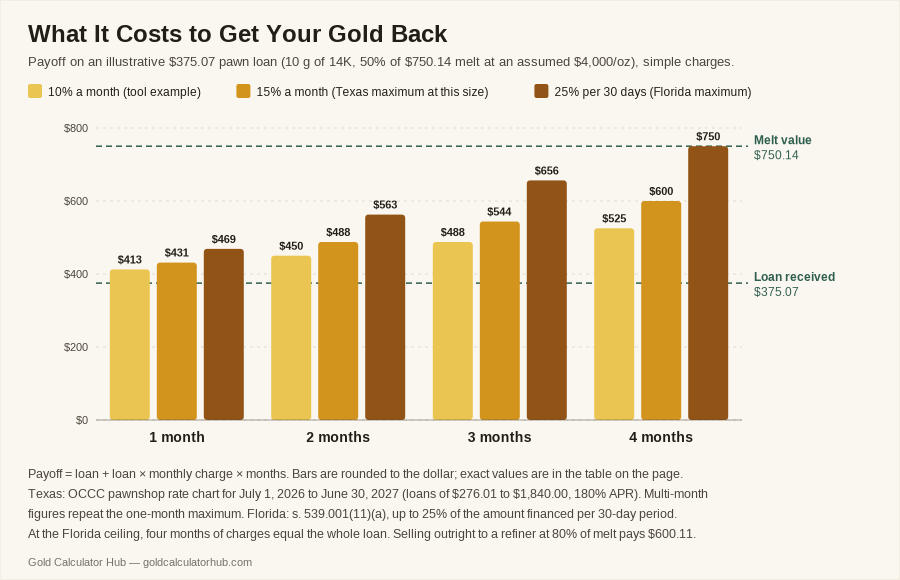
At the Florida ceiling, four months of charges equal the entire loan: you would pay $750.14 to recover a piece containing $750.14 of gold at the assumed price.
How to calculate your redemption amount
The redemption amount is the figure you must hand over to walk out with your gold. With simple monthly charges, as the tool uses, it takes five steps. The worked numbers are the illustrative 10 g of 14K at $4,000 per ounce.
- Find the melt value. Grams × purity × price per gram of pure gold: 10 × 0.5833 × $128.60 = $750.14. The homepage calculator or the scrap gold calculator does this at the live price.
- Find the loan. Melt × the loan share you were offered: $750.14 × 50% = $375.07. If the shop names a dollar amount instead, use that amount directly; it is the "amount financed".
- Find one month's charge. Loan × monthly rate: $375.07 × 10% = $37.51. Use the rate on your ticket, which must not exceed your state's ceiling.
- Multiply by the months you expect to hold it. $37.51 × 3 = $112.52. If the ticket charges by 30-day period, count periods, not calendar months.
- Add the loan back. $375.07 + $112.52 = $487.59 to redeem after three months.
To compare with other credit, the tool shows the monthly rate × 12 as a simple annual figure: 10% a month is 120% a year. The APR on your ticket is calculated under Regulation Z, whose commentary says the term used for the APR is the period agreed with the pawnbroker and does not include any grace period after the redemption date. So the ticket's APR can differ from a quick monthly × 12.
One refinement matters: charges can run by whole period, so redeeming on day 31 may cost two periods. Florida's statute lets a shop collect twice the 30-day amount for redemptions after 30 days. Ask your shop before you assume a pro-rated figure.
Reading the pawn ticket line by line
The ticket is the contract, and the gold pawn loan calculator is only useful if you enter the numbers printed on it. Florida's statute lists what its pawnbroker transaction form must show (s. 539.001(8)(b)6):
- Amount financed: the money advanced to you.
- Maturity date: 30 days after the pawn.
- Default date and the amount due on that date.
- Finance charge: the total pawn service charge payable at maturity.
- Total of payments: the amount financed plus the finance charge, which is what you pay to redeem.
- Annual percentage rate, computed under the federal rules.
The Regulation Z commentary defines the same pieces from the federal side: the amount financed is the initial sum paid to you, and the finance charge is the difference between that sum and the redemption price plus any other finance charges (CFPB comment 17(c)(1)-18).
Also check that the item description states karat and weight, and keep the ticket safe: under Florida law a lost ticket must be reported to the pawnbroker in writing by certified or registered mail, and the shop may charge up to $2 to replace it.
Pawn it or sell it? The same chain, two outcomes
A pawn loan makes sense only if you want the gold back. If you do not, the arithmetic usually favors selling it to the best buyer you can reach.
Take the illustrative 10 grams of 14K, melt value $750.14:
- Sell to a pawn shop: our selling guides put outright offers at 40–60% of melt, or $300.06 to $450.08. At 50% you receive $375.07, the same cash as the example loan, and the piece is gone.
- Sell to an online refiner: at the 70–90% our guides publish, $525.10 to $675.13. At 80%, $600.11.
- Pawn and redeem in 3 months: you receive $375.07 now and pay back $487.59. The loan costs $112.52, and you keep the piece.
- Pawn and let it forfeit: you keep $375.07 and lose $750.14 of gold. Compared with selling to a refiner at 80%, that is $225.04 less money for the same piece.
A useful break-even: at the 10% example rate, holding the loan for six months costs $225.04 in charges, so the payoff ($600.11) equals what an 80% refiner would have paid for the piece outright. If you expect to need longer, or doubt you can repay, a pawn loan is the costliest route to cash.
Pawning wins on two counts: you keep a piece that may matter more to you than its melt value, such as a wedding band, and in states with rules like Florida's there is no personal liability. If you cannot repay, you lose the item and nothing more.
Before you sign the pawn ticket
Run through this list at the counter.
- Know your melt value before you walk in. Weigh the piece, confirm the karat and run the numbers, so you can see the loan as a percentage of melt.
- Ask for both offers. Get the loan amount and the outright purchase price for the same piece, then decide.
- Read the finance charge and the APR on the ticket, not just the monthly figure said out loud. Federal rules require the disclosure.
- Check the rate against your state's ceiling. Texas publishes its chart through the OCCC; Florida's cap is in s. 539.001. Other states have their own laws; look up yours.
- Write down the maturity date and the last day you can redeem, including any grace period, and set a reminder a week earlier.
- Ask how partial months and extensions are charged, and get any extension in writing.
- Check the item description for karat, weight and any stones, so the piece returned is the piece you left.
- Enter the ticket's numbers in the gold pawn loan calculator above for the number of months you realistically need, and make sure you can afford that payoff.
- Only pawn what you can bear to lose. If repaying is unlikely, compare the forfeit outcome with selling to the best buyer before you sign.
Every number here is an illustration at an assumed gold price and example rates; your shop's offer, your state's law and the live price decide the real figures.

Written by Sukie Gao
Sukie Gao holds a master's degree from a business school, where she picked up the markets-and-pricing toolkit she now applies to the consumer gold trade. She created Gold Calculator Hub to give people an independent, data-driven way to find out what their gold is really worth.
Published November 16, 2026