Gold Hallmark Identification Chart: Every Stamp, What It Guarantees, What It's Worth
 By Sukie Gao · October 23, 2026
A gold hallmark identification chart earns its place the first time a tiny fraction in front of a karat number saves someone from paying solid-gold money for a gold-filled chain. A single inherited jewelry box can carry half a dozen marking systems at once — American karat stamps, a French eagle's head, a Birmingham anchor, an Italian star-and-number, a BIS triangle — and none of them explains itself. The chart below is the lookup table for that box: find the stamp, read across to what it legally guarantees, and land on the value tier that tells you whether to weigh the piece for its metal or admire it for its design. Every row is sourced — the US rows to the FTC's jewelry guides, the UK rows to the assay offices, the Indian rows to the Bureau of Indian Standards — and the value tiers feed straight into the gold calculator.
How to use this chart in thirty seconds
Find the stamp on the piece — inside a ring band, on the clasp tongue or the small flat tag beside it, on a pendant bail, inside a watch caseback, on an earring post. Use a 10× loupe and light from the side; phone cameras blur the strike. Then match what you see to one of the eight rows in the chart.
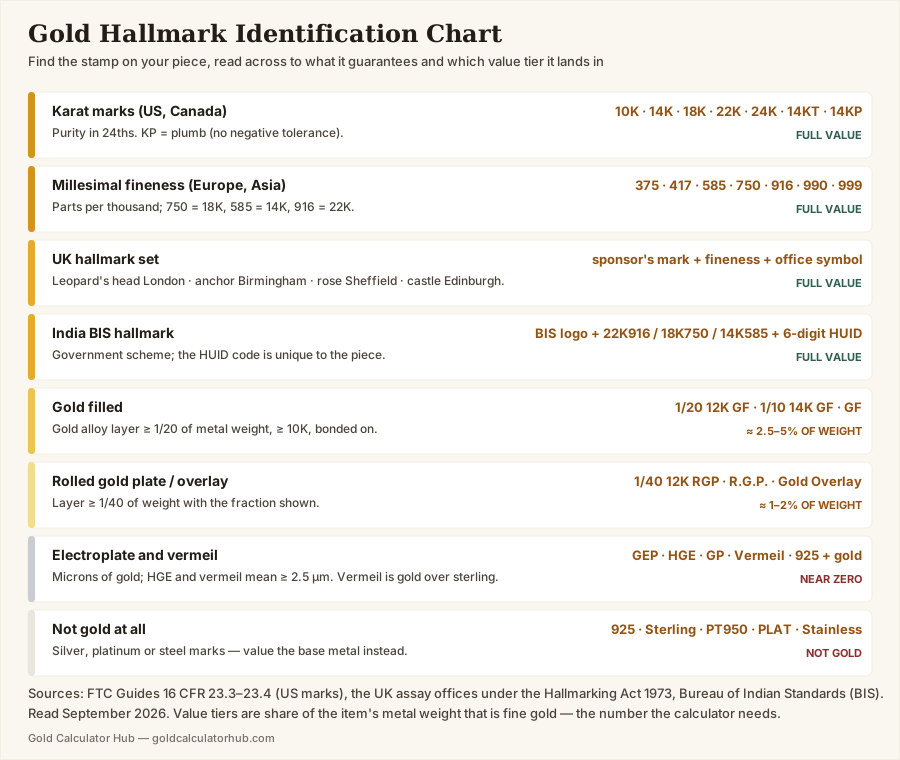
The right-hand column is the one that matters for money. Full value means the whole piece is gold alloy of the stated purity — weigh it, multiply, and you have the melt value. A share of weight means a real gold layer over base metal, worth a few percent of what the scale implies. Near zero and not gold mean the metal value is in something other than gold, or in nothing at all. The sections below take each row in turn, with the marks you will actually meet and the ones that trip people up.
What do American karat marks guarantee?
| Stamp | Gold content | Also seen as |
|---|---|---|
| 24K | 99.9% | 24KT, 999, 9999 |
| 22K | 91.67% | 22KT, 916, 917 |
| 21K | 87.5% | 875 |
| 18K | 75% | 18KT, 750 |
| 14K | 58.33% | 14KT, 585, 583 |
| 10K | 41.67% | 10KT, 417 |
| 9K | 37.5% | 375 |
A karat is one twenty-fourth. The stamp asserts the minimum fineness of the alloy throughout the piece; there is no separate layer to worry about. Two suffixes change nothing about the gold content but tell you something about the maker: KT is simply an older abbreviation, and KP — "karat plumb" — is a maker's promise that the alloy is exactly the stated karat with no negative tolerance, a distinction that mattered more before US stamping rules tightened the allowed tolerance.
What a bare karat mark does not do is prove anything. It is a manufacturer's claim, and US law requires a registered trademark beside it precisely so that someone is accountable for the claim; a karat stamp with no maker's mark next to it is legal only in narrow cases and is worth testing. The gold hallmarks guide covers where the marks hide and what a missing trademark means; the gold purity chart has the same karat table with per-gram values.
Millesimal fineness — parts per thousand
Most of the world stamps purity in thousandths rather than twenty-fourths, and the two systems are just different units for the same number: 750 is 18K, 585 is 14K, 916 is 22K. The conversion is karat ÷ 24 × 1000.
| Fineness | Karat | Where you meet it |
|---|---|---|
| 999 / 9999 | 24K | Bullion, Chinese and Hong Kong pieces sold as pure gold |
| 990 | 23.76K | UK standard added in 1999; uncommon |
| 916 / 917 | 22K | India, the Gulf, UK 22ct |
| 875 | 21K | Middle East, Turkey, Portugal |
| 750 | 18K | Europe, Asia, most fine jewelry worldwide |
| 585 / 583 | 14K | Europe (585), Soviet-era pieces (583) |
| 417 | 10K | US pieces marked in thousandths |
| 375 | 9K | UK, Australia, South Africa |
Two details separate a confident reading from a guess. First, 583 and 585 are both 14K — Soviet and Eastern-bloc makers used 583 for decades, and the site's karat constants treat them as equivalent. Second, a three-digit number on its own is not always a fineness mark: 925 is sterling silver, 950 with PT or PLAT is platinum, and a four-digit number on a watch is usually a model reference. The gold fineness chart plots every mark on one scale if you want to see how uneven the steps really are.
Why is a UK hallmark the only mark you can trust without testing?
British hallmarks are different in kind from every other row on this chart. A karat stamp is the maker's claim; a UK hallmark is an assay office's certification that it tested the metal, applied under the Hallmarking Act 1973 by one of the four UK assay offices. That is why a genuine UK-hallmarked piece is the one you can weigh and value without a second thought.
The compulsory set has three parts, struck as a group:
- Sponsor's mark — the maker's or importer's initials in a shield or cartouche.
- Millesimal fineness — for gold, one of 375, 585, 750, 916, 990 or 999, inside an octagon-shaped surround that itself signals "gold" (silver and platinum use different shapes).
- Assay office mark — a leopard's head for London, an anchor for Birmingham, a rose for Sheffield, a castle for Edinburgh.
Two further marks are optional since 1999 and common on older pieces: a date letter that specialists use to year the piece, and the traditional crown that historically denoted gold. A piece with only some of the set is either pre-1999, foreign-made with a partial import mark, or not hallmarked at all — and the last case means it is a claim again, not a certification.
For valuation the practical rule is simple: read the fineness number from the octagon and treat it as exact. The how much is 18K gold worth page runs the numbers for the 750 mark that dominates UK fine jewelry; 375 pieces use the 9K row of any karat calculator.
India's BIS hallmark — logo, grade, HUID
Indian gold carries the Bureau of Indian Standards hallmark, which under the mandatory regime in force since 2021 has three components struck together:
- The BIS logo — a triangle mark.
- The purity and fineness grade — written as both, for example 22K916, 18K750, 14K585.
- A six-digit alphanumeric HUID (Hallmark Unique Identification) that is specific to the individual piece and can be checked against the BIS database.
The grade is what the calculator needs: 22K916 is 91.67% gold, exactly as a Western 916 or 22K mark would be. The HUID is what makes the Indian system closer to the UK's than to the American one — a piece with a valid HUID has passed through an assay and hallmarking centre rather than being self-stamped by the maker. Older Indian pieces may carry the earlier BIS format with a jeweller's identification mark and an assay-centre mark in place of the HUID; the fineness number is read the same way.
Most of the Indian gold that reaches Western counters is 22K, heavy, and sold by weight in its home market, which makes it the single easiest category on this chart to value: weight × 0.9167 × the price of pure gold. The 22K gold calculator is preset for it.
Gold filled and rolled gold plate — the fraction changes everything
Any stamp with a fraction in front of the karat is describing a layer, not the whole piece. The fraction is the layer's share of the metal weight; the karat is the layer's purity; multiply them for the piece's real gold content.
| Stamp | Layer share | Layer purity | Fine gold in the piece |
|---|---|---|---|
| 1/10 14K GF | 10% | 58.33% | 5.83% |
| 1/10 12K GF | 10% | 50% | 5.00% |
| 1/20 14K GF | 5% | 58.33% | 2.92% |
| 1/20 12K GF | 5% | 50% | 2.50% |
| 1/20 10K GF | 5% | 41.67% | 2.08% |
| 1/40 12K RGP | 2.5% | 50% | 1.25% |
The FTC's rules fix the thresholds. "Gold filled" (GF, G.F.) may only be used when a mechanically bonded layer of at least 10-karat gold makes up at least one-twentieth of the metal weight. Below that, down to one-fortieth, the same construction must be called "rolled gold plate" (RGP, R.G.P.) or "gold overlay," with the fraction shown. A bare GF with no fraction still has to meet the 1/20 minimum, so read it as 1/20 at 10K — about 2% fine gold — for a conservative estimate.
These pieces are real gold in small quantity. They are worth decoding precisely, and the 1/20 12K GF page does the full decode for the commonest stamp; the gold filled calculator turns any of them into a dollar figure. What they are not is jewelry-counter scrap: a pawn shop or jeweler cannot recover 2.5% gold from brass and will decline or offer a token amount. Refiners with a published gold-filled rate are the outlet, usually above a minimum lot weight.
Which stamps mean almost nothing?
The bottom two rows of the chart are where most expensive mistakes happen, because the pieces look identical to solid gold and the stamps sound reassuring.
GEP, GP, gold electroplate. An electrolytic gold film measured in microns of thickness rather than in a weight fraction. The FTC minimum for the plain term is 0.175 microns; for HGE (heavy gold electroplate) it is 2.5 microns. Even the heavy grade amounts to a negligible share of the piece's weight — a hundredth of a percent or less — so the recoverable gold rounds to zero and no buyer pays for it. Marks like "18K GEP" or "14K HGE" are describing the purity of a film you cannot sell.
Vermeil. Gold over sterling silver, at least 10-karat and at least 2.5 microns thick by the FTC definition. The gold layer is worth nothing recoverable; the silver base is worth silver melt. Look for 925 beside the gold mark.
"18K gold-tone," "gold color," "gold finish." Not gold in any regulated sense. Costume.
925, Sterling, PT950, PLAT, Stainless, Titanium. Not gold at all — silver, platinum or steel marks. A piece stamped 925 with a gold appearance is vermeil or gold-plated silver, and the gold plated jewelry value guide explains why even a refiner will only pay for the silver.
The common thread: a karat number next to a layer term (GEP, HGE, GP, vermeil, gold-tone) describes the layer, never the piece. When in doubt, the how to tell real gold from fake tests separate a plated piece from a solid one in a minute, and a buyer will run them whether you do or not.
Maker's marks, country marks and the stamps that aren't purity at all
A great deal of what is struck on jewelry has nothing to do with gold content, and reading it as if it did causes confusion in both directions.
| Mark | What it is | Purity? |
|---|---|---|
| Maker's / sponsor's mark — initials, logo, registered trademark | Who is accountable for the piece; in the UK, part of the hallmark set | No — but the legal companion to a karat stamp |
| Italian star + number + province code (e.g. "*123 AR") beside a 750 | Manufacturer registration | No — the 750 beside it is the purity |
| French eagle's head | State assay mark for 18K gold | Yes — a certification, not a claim |
| Chinese / Hong Kong 足金 (chuk kam, "sufficient gold") | Pure-gold designation; a numeric 999 is usually struck alongside | Read the number — the legal minimum behind the characters differs between Hong Kong and the mainland |
| Serial numbers, model references, movement calibres | Watch and clasp identifiers | No — a four-digit number on a watch case is a reference, not a fineness |
| Ring sizes, stone weights ("0.25ct"), patent numbers | Sizing and manufacturing data | No |
When a piece carries several marks, the rule is to find the purity mark first — a karat, a millesimal number in the right surround, a BIS grade — and treat everything else as context. The gold basics guides cover each of these systems in more depth; the gold percentage to karat chart is the reverse lookup for when a piece shows a percentage rather than a mark. And the last step is always the same: weight × purity × the live price, which the karat gold calculator does for any mark on this page.
Frequently Asked Questions
What is the most reliable gold hallmark?
A UK assay office hallmark, followed by other state assay marks such as the French eagle's head and India's BIS hallmark with a HUID. Each of those is an independent body certifying that it tested the metal. American karat stamps and European millesimal numbers are manufacturer's claims — usually accurate, but a claim rather than a certification, which is why a maker's mark beside them matters.
How do I identify a gold hallmark on a ring?
Look inside the band with a 10× loupe under side lighting. You are searching for a karat (10K, 14K, 18K), a three-digit fineness (417, 585, 750) or a full hallmark set, plus a maker's mark. A fraction in front of the karat (1/20 12K GF) means gold-filled; letters like GEP or HGE mean plated. If the band is worn smooth, an acid test will establish the karat regardless of the stamp.
Does a hallmark guarantee my gold is real?
A state assay hallmark comes close — it certifies that the assay office tested the metal. A karat or fineness stamp on its own guarantees only that the maker claimed that purity; it can be struck on anything. The practical test is simple: any buyer will verify with acid or an electronic tester before paying, so a stamp tells you what to expect at the counter, not what you will get.

Written by Sukie Gao
Sukie Gao holds a master's degree from a business school, where she picked up the markets-and-pricing toolkit she now applies to the consumer gold trade. She created Gold Calculator Hub to give people an independent, data-driven way to find out what their gold is really worth.
Published October 23, 2026