10K vs 14K Gold: Is 40% More Gold Worth the Price Gap?
 By Sukie Gao · November 28, 2026
Quick answer
14K holds 40% more gold than 10K: 58.33% against 41.67%. At an assumed $4,000 per troy ounce ($128.60 per gram of pure gold), a gram of 10K contains $53.59 of gold and a gram of 14K $75.01, a gap of $21.42 per gram. Retail guides describe 10K as paler and more scratch resistant, 14K as richer in color. At resale, buyers pay for the gold content.
10K vs 14K gold value comparison
Live gold price: $3,650.00/ozt · updates every 10 min
10K gold content
$244.50
2.084 g pure gold
14K gold content
$342.25
2.917 g pure gold
Difference in gold
$97.75
14K holds 40% more gold than 10K
Same weight, metal value only: weight × purity × live price per gram. In real jewelry a higher-karat piece of the same design is also slightly heavier, because gold is denser than its alloy metals, and retail prices add labour and markup on top of the metal.
16.66 percentage points of gold is the entire difference in the 10K vs 14K gold question: 10K is 41.67% gold (stamped 417) and 14K is 58.33% (stamped 585 or 583), which means 14K carries 40% more gold in every gram, and at an assumed $4,000 per troy ounce that is $53.59 of gold in a gram of 10K against $75.01 in a gram of 14K, a gap of $21.42. Everything else people argue about, from color and scratch resistance to skin reactions and price tags, follows from that one ratio of gold to other metals. This page puts numbers on the part that can be measured, which is the gold you are paying for and the gold you can get back when you sell, and it reports the softer claims (durability, color, allergies) as what jewelry retail guides say rather than as lab data, because no primary source we could find measures them. It also corrects a myth that several buying guides repeat about 10K being the legal floor in the US, walks through a class ring like the 1945 Birks ring pictured below, and ends with a short list of who should buy which. The comparison tool above runs both karats side by side at the live price for any weight you enter.
The 40% gap, in grams and dollars
Divide the two purities and the answer is fixed at any gold price: 0.5833 ÷ 0.4167 = 1.40, so 14K has 40% more gold than 10K. Read the other way, a 10K piece holds about 71% of the gold of an identical 14K piece.
The table puts that into grams and dollars for common weights, at the assumed $4,000 per troy ounce ($128.60 per gram of pure gold, from 4,000 ÷ 31.1035):
| Item weight | Pure gold in 10K | Pure gold in 14K | Extra gold in 14K | Melt value 10K | Melt value 14K | Extra melt value |
|---|---|---|---|---|---|---|
| 3 g (light ring or pendant) | 1.25 g | 1.75 g | 0.50 g | $160.76 | $225.04 | $64.28 |
| 5 g (band) | 2.08 g | 2.92 g | 0.83 g | $267.94 | $375.06 | $107.12 |
| 10 g (heavy ring or bracelet) | 4.17 g | 5.83 g | 1.67 g | $535.88 | $750.12 | $214.24 |
| 25 g (chain) | 10.42 g | 14.58 g | 4.17 g | $1,339.69 | $1,875.31 | $535.62 |
The last column is the part of a price difference you can actually recover. A store's price gap between a 10K and a 14K version of the same design also includes labor and markup, which nobody pays back when you sell. If a retailer asks much more than the extra melt value for the 14K version, most of the extra is margin, not metal.
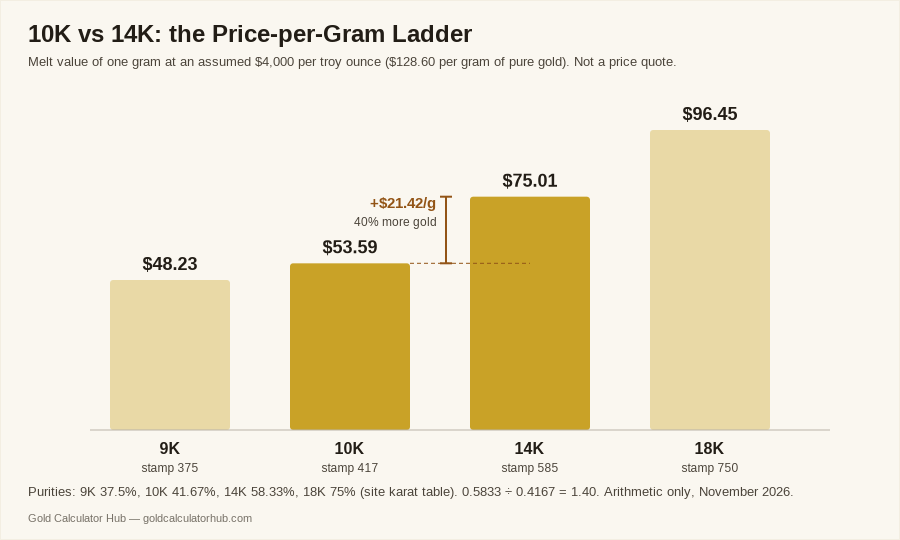
The ladder shows why 10K vs 14K gold is the widest single step most shoppers face: 14K sits $21.42 per gram above 10K, while 10K sits only $5.36 above 9K.
Why 10K is not the US legal minimum
Several buying guides state that 10K is the lowest purity that can legally be sold as gold in the United States. The federal rule says otherwise. The FTC's Jewelry Guides, 16 CFR Part 23, set out how gold may be marked and described, and section 23.3(c)(1) accepts a marking of "9 Karat Gold". The 10K figure that does appear in the rules is the minimum fineness for the gold layer on gold-filled, gold-plated and vermeil products, not a floor for solid gold.
What is true is narrower: 10K is the lowest karat commonly sold in American stores, while 9K (37.5%) is a standard in the UK and elsewhere. If you have a piece stamped 9K or 375, the 9K gold calculator values it.
The marks themselves are straightforward:
- 10K: stamped 10K, 10KT or 417.
- 14K: stamped 14K, 14KT, 585 or, on some older and Eastern European pieces, 583.
- 10KGF, 1/20 10K GF, 10K GP or 10K RGP: gold-filled or plated. The 10K describes the thin gold layer only, and the piece is worth a small fraction of solid 10K.
The FTC's consumer page on buying gold jewelry explains the same marking terms in plain language. For maker's marks, country marks and the stamps that do not mean what they seem, the gold hallmarks guide goes further. A stamp is a claim, not a test: anything you plan to sell should be tested by the buyer in front of you.
Hardness, color and skin reactions
None of the sources in this site's register measure hardness, color or allergy rates for these alloys, so this section reports the consensus of jewelry retail guides and explains the reasoning behind it, without inventing numbers.
Durability. Pure gold is soft. Both karats are hardened by the metals mixed into them, and 10K contains more of those metals: about 58% of its weight against about 42% in 14K. Retail guides therefore mostly describe 10K as the harder, more scratch-resistant choice, which is why it is often suggested for rings worn every day at work or by people hard on their hands. Exact behavior depends on the specific alloy recipe, which varies between manufacturers.
Color. With less gold, yellow 10K looks paler and slightly less warm than yellow 14K. Side by side the difference is visible; on its own, many people do not notice it. In white gold the comparison matters less, because white pieces are usually rhodium plated and the plating sets the visible color.
Skin reactions. A higher share of alloy metals means more exposure to them. Guides flag nickel, used in some white gold alloys, as the usual cause of reactions. If you know you react to nickel, ask the seller what the alloy contains rather than relying on the karat alone; a 14K white piece can contain nickel too.
Price. Because it contains less gold, 10K costs less at the same weight. That is the main reason it is popular for class rings, men's rings and budget pieces. Retail guides commonly recommend 14K as the balance between color, gold content and wear.
A 10K class ring priced, then priced again as 14K
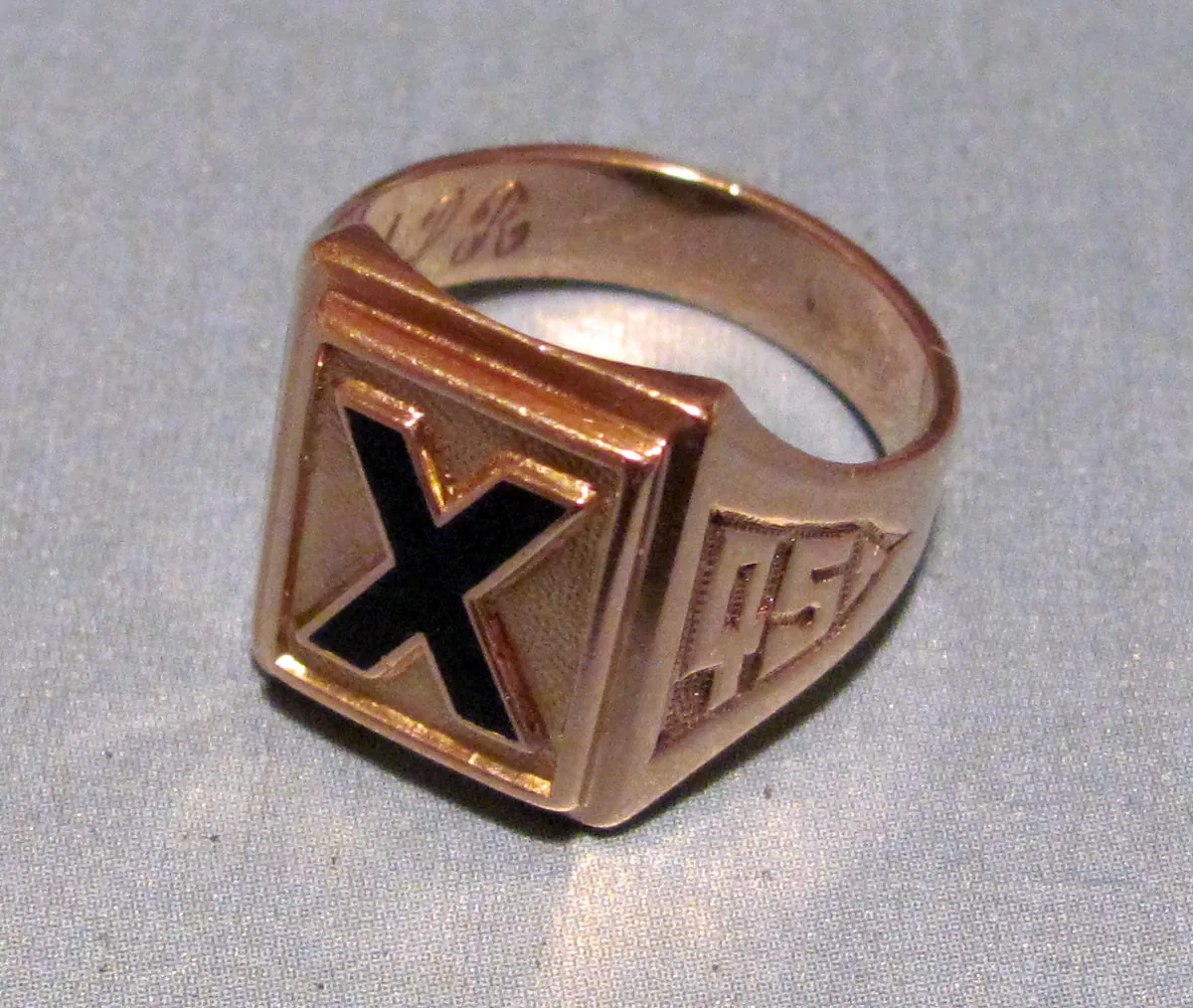
The ring in the photo below is a St. Francis Xavier University class ring for the year of 1945, which its Commons description says Birks made in 10K gold. The pictured ring is Canadian, but class rings sold in the US are also commonly 10K or 14K, so the same arithmetic applies to the question most owners have. The weight used here is illustrative: assume the ring weighs 9 grams on a gram scale.
At 10K: 9 g × 0.4167 = 3.7503 g of pure gold. At $128.60 per gram that is $482.29 of melt value.
The same ring in 14K: 9 g × 0.5833 = 5.2497 g of pure gold, worth $675.11. The difference is $192.82, which is the 40% gold gap in dollars.
Deduct what is not gold. Class rings often carry a synthetic or glass stone, sometimes a set center stone and enamel or a filled face. A buyer weighs the gold, not the stone. If an illustrative 1.5 g of that 9 g is stone and setting material, the gold weight is 7.5 g, and the 10K melt value falls to 7.5 × 0.4167 × $128.60 = $401.91. The gold ring value calculator walks through estimating stone weight when the stone cannot be removed.
Offers on the full 9 g at the site's typical payout ranges (editorial estimates, not measured data):
| Buyer type | Share of melt | 10K ring ($482.29) | Same ring in 14K ($675.11) |
|---|---|---|---|
| Online refiner | 70–90% | $337.60 – $434.06 | $472.58 – $607.60 |
| Coin or bullion dealer | 65–85% | $313.49 – $409.95 | $438.82 – $573.84 |
| Jewelry store | 50–75% | $241.15 – $361.72 | $337.56 – $506.33 |
| Pawn shop | 40–60% | $192.92 – $289.37 | $270.04 – $405.07 |
| Mail-in service | 20–50% | $96.46 – $241.15 | $135.02 – $337.56 |
One more check before melting an old school ring: a dated or unusual ring can mean more to the school's alumni or to a collector than to a refiner, so it is worth asking before you sell it for metal.
What a buyer pays back for each
At resale the comparison is almost mechanical. A buyer applies the same share of melt to 10K and 14K, so a 14K piece always brings about 1.40 times what the same weight of 10K brings, at any gold price and any buyer.
For a 10 g chain at the assumed price:
| Buyer type | 10K chain (melt $535.88) | 14K chain (melt $750.12) |
|---|---|---|
| Online refiner, 70–90% | $375.12 – $482.29 | $525.08 – $675.11 |
| Pawn shop, 40–60% | $214.35 – $321.53 | $300.05 – $450.07 |
Three things follow for anyone deciding what to buy with resale in mind:
- Retail markup does not come back. You recover a share of the gold, not the design, labor or store margin. On light pieces those make up much of the shelf price, in either karat.
- The karat gap shows at the counter. The extra $214.24 of gold in the 14K chain becomes roughly $86 to $193 more cash, depending on the buyer.
- Weight matters more than karat for heavy pieces. A 15 g 10K chain holds more gold than a 10 g 14K chain (6.25 g against 5.83 g), so compare pure gold grams, not stamps.
Chains add their own wrinkles, such as clasps and hollow links. The gold chain value calculator covers those, and the gold calculator gives today's melt value for any karat and weight.
A short decision list
Most of the 10K vs 14K gold decision comes down to how the piece will be worn and whether you care more about price or gold content.
Choose 10K if:
- The piece will take hard daily wear, such as a work ring, and retail guides' point about scratch resistance matters more to you than color.
- Budget is the main constraint and you would rather have a heavier or larger 10K design than a lighter 14K one.
- It is a class ring, a men's signet or another traditional style commonly made in 10K.
- You do not react to the alloy metals, or the seller can confirm a nickel-free alloy.
Choose 14K if:
- You want a warmer yellow and more gold for the money spent on metal.
- The piece is an heirloom or a wedding band, where the 40% extra gold is part of the point.
- You may sell it one day and want the higher melt value per gram.
- You have sensitive skin and want less alloy overall, while still asking what the alloy contains.
Either way: compare the price gap between the two versions with the extra melt value in the first table. If the store asks far more than the gold difference, you are paying for margin. And whatever you buy, keep the receipt and note the weight, which makes any future sale or insurance claim easier.
Frequently Asked Questions
Can you tell 10K from 14K without a stamp?
Not reliably by eye. Yellow 10K is usually a little paler, but alloy recipes, plating and wear blur the difference, and white gold is normally rhodium plated, which hides it entirely. Weight does not help either unless you know the exact design. The dependable methods are an acid test, which brackets the karat using solutions calibrated for 10K and 14K, and an XRF analyzer, which reads the gold percentage directly. Most dealers and refiners will test a piece for free before making an offer.
Is an old or worn 10K piece worth less than a new one?
As scrap, only by the metal it has lost. Melt value depends on weight and purity, so a ring worn thin over decades is worth less because it weighs less, not because it is old. Scratches and dents cost nothing at the scale. Age can add value instead when the piece has collector, brand or sentimental appeal, such as a dated class ring or a signed maker's piece. Weigh it on a gram scale and multiply by 0.4167 and the price of pure gold to get the floor.

Written by Sukie Gao
Sukie Gao holds a master's degree from a business school, where she picked up the markets-and-pricing toolkit she now applies to the consumer gold trade. She created Gold Calculator Hub to give people an independent, data-driven way to find out what their gold is really worth.
Published November 28, 2026