How Much Is a Pound of Gold Worth? Troy, Regular and Karat Pounds
 By Sukie Gao · November 24, 2026
Quick answer
That depends on which pound. At an assumed $4,000 per troy ounce, a regular (avoirdupois) pound of pure gold holds 14.58 troy ounces and is worth about $58,333; a troy pound holds 12 troy ounces and is worth $48,000. A pound of 14K jewelry holds about $34,026 of gold, and a buyer pays a share of that. The tool above uses today's price.
Pound, kilo and ton of gold calculator
Live gold price: $3,650.00/ozt · updates every 10 min
Total weight
14.583 ozt
453.6 grams
Pure gold inside
14.569 ozt
99.9% of the weight
Melt value
$53,175.94
at the live spot price, before any buyer margin
Math: amount × grams per unit ÷ 31.1035 g per troy ounce × purity × live price per troy ounce. A bullion dealer buying fine bars pays close to this; a buyer of karat scrap pays a share of it.
453.59 grams, 373.24 grams and 1,000 grams are the three weights hiding behind the question how much is a pound of gold worth: the everyday avoirdupois pound on a bathroom or postal scale, the old troy pound of the precious-metals trade, and the kilogram that many people really mean when they picture a heavy bar. At an assumed $4,000 per troy ounce they come to $58,333, $48,000 and $128,603 of pure gold. That is a $10,333 gap between the two pounds alone, which is why the unit has to be settled before any price is.
The tool above converts any of these weights (plus short, long and metric tons) at the live price and lets you pick a karat, because a pound of 14K jewelry is a very different thing from a pound of bullion. Below are the unit definitions, a karat-by-pound table, the ton figures people search for, how big a pound of gold actually is, and what real buyers pay for a pound of scrap versus a bar. Every dollar figure uses the $4,000 assumption so the math can be checked; for today's number, use the tool or the gold calculator.
Which pound is on the scale?
Two pounds are legally defined in the United States, and gold has used both. The avoirdupois pound is the ordinary one: 16 ounces of 28.35 grams, or exactly 453.59237 grams. Anything you weigh at home, at the post office or on a bathroom scale is in avoirdupois pounds. The troy pound is 12 troy ounces of 31.1035 grams each, or 373.2417 grams. Both definitions come from NIST Handbook 44, Appendix C, the reference US weights-and-measures officials use.
The gold market prices in troy ounces, but it no longer trades in troy pounds; you will not find a troy-pound quote on any dealer screen. So when someone says they have a pound of gold, they almost always mean an avoirdupois pound of metal, which works out to 14.5833 troy ounces. When a news story or a price site talks about a troy pound, it is usually doing arithmetic, not describing a real trading unit.
The practical rule: weigh in grams if you can, and convert to troy ounces by dividing by 31.1035. That removes the pound question entirely.
Every big unit of gold, converted
Here is each unit people use for large amounts of gold, in grams and troy ounces, with the value of that weight in pure gold at the assumed $4,000 per troy ounce ($128.60 per gram).
| Unit | Grams | Troy ounces | Pure gold value |
|---|---|---|---|
| Troy ounce | 31.1035 | 1 | $4,000 |
| Troy pound | 373.2417 | 12 | $48,000 |
| Avoirdupois pound | 453.5924 | 14.5833 | $58,333 |
| Kilogram | 1,000 | 32.1507 | $128,603 |
| Short ton (2,000 lb) | 907,184.74 | 29,166.67 | $116.67 million |
| Metric tonne (1,000 kg) | 1,000,000 | 32,150.75 | $128.60 million |
| Long ton (2,240 lb) | 1,016,046.91 | 32,666.67 | $130.67 million |
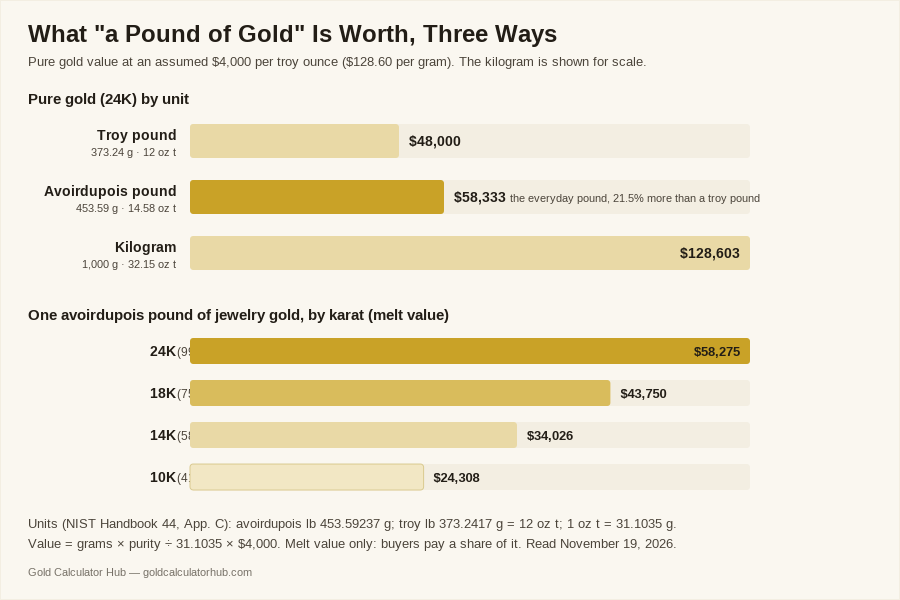
The kilogram is here because large bars and many international quotes use it: a kilogram is 2.2046 avoirdupois pounds, so a kilo of gold is worth a little more than twice an everyday pound.
The 9.7% shortcut error, and the bigger 18% one
Two mistakes account for most of the bad pound figures in circulation.
The first is multiplying the troy-ounce price by 16, because a pound has 16 ounces. Those are avoirdupois ounces of 28.35 g, not troy ounces of 31.10 g. At $4,000, the shortcut gives $64,000 when the real figure is $58,333, an overstatement of $5,667 or about 9.7%. A seller who walks in expecting $64,000 will read every honest offer as a lowball, which is exactly the wrong frame for comparing buyers. The troy ounce vs ounce page covers the ounce version of this trap.
The second runs the other way and costs real money. If metal that weighs one avoirdupois pound gets priced as a troy pound, the buyer pays for 12 troy ounces instead of 14.58. At the assumed price that is $48,000 instead of $58,333: $10,333 short, or 17.7% of the true value. The defense is the same as before: insist the lot is weighed in grams on a legal-for-trade scale and see the gram figure written down.
What a pound of 10K, 14K, 18K or 22K jewelry holds
A pound of jewelry is mostly not gold unless it is 22K or 24K. Multiply the weight by the karat's purity to get the pure gold inside, then price that. The table uses the site's standard purities and the $4,000 assumption.
| Karat (mark) | Purity | Pure gold in 1 avoirdupois lb | Value, avoirdupois lb | Value, troy lb |
|---|---|---|---|---|
| 24K (999) | 99.9% | 453.14 g | $58,275 | $47,952 |
| 22K (917) | 91.67% | 415.81 g | $53,474 | $44,002 |
| 21K (875) | 87.5% | 396.89 g | $51,042 | $42,000 |
| 18K (750) | 75% | 340.19 g | $43,750 | $36,000 |
| 14K (585) | 58.33% | 264.58 g | $34,026 | $27,998 |
| 10K (417) | 41.67% | 189.01 g | $24,308 | $20,002 |
| 9K (375) | 37.5% | 170.10 g | $21,875 | $18,000 |
These are melt values, the ceiling for what the gold is worth as metal. Stones, steel clasps, solder-filled hollow pieces and gold-filled or plated items all weigh something and hold little or no gold, so a mixed drawer that weighs a pound usually melts below the karat line it seems to match.
100 pounds of gold
One hundred avoirdupois pounds is 45,359.24 grams, or 1,458.33 troy ounces. In pure gold at the assumed $4,000 that is $5,833,333. If the same 100 pounds were 14K jewelry, the gold inside would be worth $3,402,583, and in 10K about $2,430,750.
The weight sounds like a pile; the volume is not. Gold's density is 19.3 grams per cubic centimeter according to the Royal Society of Chemistry periodic table, so 100 pounds of pure gold fills about 2,350 cubic centimeters, roughly 2.35 liters. That is only a little more than a standard 2-liter soda bottle holds.
Nobody sells 100 pounds of gold to a pawn shop. At this scale the metal would be bars handled by refiners, banks and bullion wholesalers, priced against spot rather than at a percentage of melt. The question mostly comes up in fiction, treasure stories and estate rumors, and the honest answer for any real lot is the same: weigh it, establish the purity, and price the pure gold.
Tons of gold to dollars
Searches for the value of 5 or 10 tons of gold usually come from news about central-bank reserves or mining output. The catch is that "ton" has three meanings, and the difference is about 12% between the smallest and the largest.
| Amount | Metric tonnes | Short tons (US) | Long tons (UK) |
|---|---|---|---|
| 1 ton | $128.60 million | $116.67 million | $130.67 million |
| 5 tons | $643.01 million | $583.33 million | $653.33 million |
| 10 tons | $1.286 billion | $1.167 billion | $1.307 billion |
All values are pure gold at the assumed $4,000 per troy ounce. The metric tonne (1,000 kg, 32,150.75 troy ounces) is the unit the gold industry and central banks report in, so a headline about "tons of gold" in reserves almost always means tonnes. The short ton of 2,000 pounds is the American everyday ton, and the long ton of 2,240 pounds is the old British one.
A metric tonne of gold, for scale, occupies about 51.8 liters at 19.3 g/cm³: a cube roughly 37 centimeters on a side.
How big a pound of gold really is
Because gold is so dense, a pound of it is small enough to close a hand around. At 19.3 g/cm³, one avoirdupois pound of pure gold has a volume of about 23.5 cubic centimeters. Formed into a cube, it would measure about 2.86 cm (1.13 inches) on each side. A troy pound is 19.3 cubic centimeters, and a kilogram is 51.8 cubic centimeters, a cube about 3.73 cm (1.47 inches) across.
Real bars are not cubes; they are flat and longer than they are wide, so a one-kilogram bar looks larger than these numbers suggest. Karat jewelry is less dense than pure gold, because the copper, silver and zinc mixed into it are lighter than gold, so a pound of 14K takes up more room than a pound of 24K.
This matters for one practical reason: if a supposed pound of solid pure gold is clearly bigger than a cube about 1.1 inches on a side, it is either not solid or not pure gold. Size alone proves nothing, though. A purity test, by acid, a tester or a refiner's assay, is what settles it.
The 400-ounce bar as a yardstick
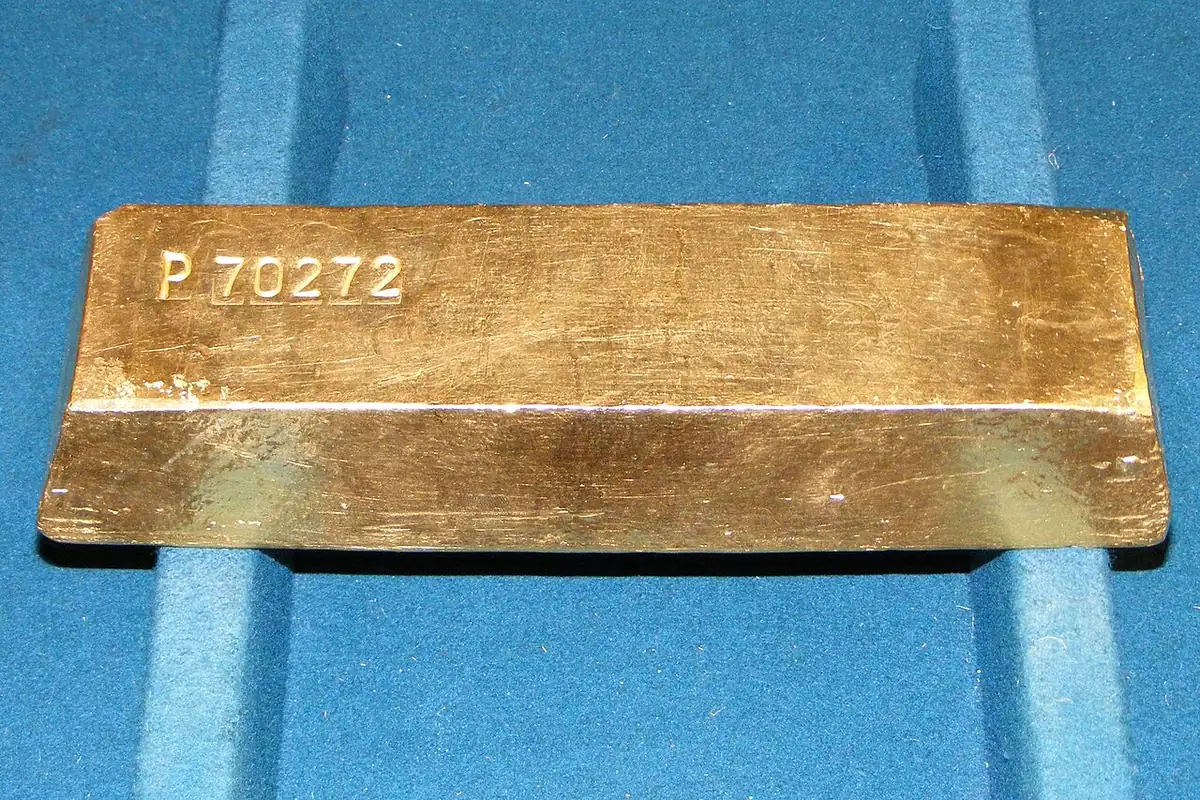
The biggest bar most people ever see in a photograph is the 400 troy ounce bar, the size normally used between banks. Converting it is a useful check on all the units above.
- 400 troy ounces = 12,441.39 grams.
- In avoirdupois pounds: 12,441.39 ÷ 453.59237 = 27.43 lb.
- In troy pounds: 400 ÷ 12 = 33.33 troy lb.
- At the assumed $4,000 per troy ounce: $1,600,000 of gold, before any adjustment for its exact fineness.
So one bar a single person can still lift carries 27.43 times the gold of an everyday pound: $1.6 million against $58,333. That also explains why the pound is a poor unit for real trading: bars are made in grams, kilograms and troy ounces, and the pound only appears when someone translates for a general audience.
If you own smaller bars, the gold bar value calculator values them by stated weight and fineness and covers how to check that what you hold matches its stamp.
What a buyer actually pays for a pound of scrap
Melt value is not an offer. A buyer of scrap jewelry pays a share of melt, and that share varies more by the type of buyer than by anything about your gold. Here is an illustrative pound of 14K scrap, melt value $34,026 at the assumed price, run through the site's typical payout ranges. These ranges are editorial estimates, not measured data.
| Buyer type | Typical share of melt | Offer on a pound of 14K |
|---|---|---|
| Online refiner | 70–90% | $23,818–$30,623 |
| Local coin or bullion dealer | 65–85% | $22,117–$28,922 |
| Jewelry store | 50–75% | $17,013–$25,519 |
| Pawn shop | 40–60% | $13,610–$20,416 |
| Mail-in TV service | 20–50% | $6,805–$17,013 |
The gap between the worst and best door is more than $23,000 on one pound. At this size, a refiner's shipping and insurance costs are small next to the difference in payout, and it is worth asking whether a refiner assays a lot this big before paying, which protects you from a buyer guessing the purity of mixed pieces low.
Selling a bullion bar instead of scrap
A bar of investment-grade gold is sold differently from a bag of jewelry. Dealers quote bars against the spot price, usually as a small discount below spot or a fixed amount per ounce, because the purity is stamped, the bar is easy to verify, and they can resell it without refining. A pound's worth of bullion, in practice a mix of kilogram, 10-ounce or 1-ounce bars and coins, will therefore fetch much closer to its melt value than the same weight of 14K scrap.
That difference is the real answer to how much is a pound of gold worth for most people who own one: the purity and the form matter as much as the weight. A pound of 24K bars and a pound of 14K chains differ by about $24,000 in gold content at the assumed price, and the bars also sell at a smaller discount.
Before accepting any bid on bullion, compare it with spot and with a second dealer. The how much below spot to sell gold page sets out what a fair discount looks like and the questions that reveal a padded spread.
Kitchen scales and other weighing traps
Weighing a pound of gold on a kitchen scale tells you roughly what you have, not what you will be paid for. Many kitchen scales display ounces to one decimal place, a step of 0.1 oz or 2.835 grams. A reading can be off by up to half a step, 1.42 grams, which on 14K is about $106 of gold at the assumed price. A scale that reads whole grams is off by up to half a gram per reading, about $38 of 14K gold.
The bigger risks are in the unit settings. A scale left on avoirdupois ounces, a buyer quoting per troy ounce, and a lot described in pounds is how the 17.7% troy-pound error from earlier gets made. Tare the container, switch to grams, and weigh each karat separately.
When money changes hands, the scale should be one approved for trade use under NIST Handbook 44 and inspected by your state's weights-and-measures office. The how to weigh gold guide covers scale types, calibration and what to watch for on a buyer's counter.
Working out your own pound, step by step
The tool above does this at the live price, but the arithmetic is short enough to check by hand. Take an illustrative estate lot of 14K jewelry that weighs 1.30 pounds on a postal scale.
- Convert to grams: 1.30 × 453.59237 = 589.67 g.
- Apply purity: 589.67 × 0.5833 = 343.95 g of pure gold.
- Convert to troy ounces: 343.95 ÷ 31.1035 = 11.0584 troy oz.
- Price it: 11.0584 × $4,000 = $44,234 in melt value at the assumption.
- Apply a buyer's range: an online refiner at 70–90% would offer about $30,964–$39,810; a pawn shop at 40–60% about $17,693–$26,540.
If the lot holds several karats, run each one separately and add them; averaging the karats hides which pieces carry the value. For a lot measured in kilograms instead, the gold price per kilo calculator runs the same steps.

Written by Sukie Gao
Sukie Gao holds a master's degree from a business school, where she picked up the markets-and-pricing toolkit she now applies to the consumer gold trade. She created Gold Calculator Hub to give people an independent, data-driven way to find out what their gold is really worth.
Published November 24, 2026