14K vs 18K Gold: Gold Content, Value per Gram and Which to Buy
 By Sukie Gao · November 26, 2026
Quick answer
18K gold is 75% gold and 14K is 58.33%, so 18K holds 28.6% more gold by weight. At an assumed $4,000 per troy ounce, a gram of 14K holds $75.01 of gold and a gram of 18K $96.45, a gap of $21.44 per gram. 18K looks richer and suits sensitive skin; 14K costs less and, per most retail guides, takes daily wear better. Resale tracks gold content only.
14K vs 18K gold value comparison
Live gold price: $3,650.00/ozt · updates every 10 min
14K gold content
$342.25
2.917 g pure gold
18K gold content
$440.06
3.75 g pure gold
Difference in gold
$97.81
18K holds 28.6% more gold than 14K
Same weight, metal value only: weight × purity × live price per gram. In real jewelry a higher-karat piece of the same design is also slightly heavier, because gold is denser than its alloy metals, and retail prices add labour and markup on top of the metal.
Same ring, two stamps: one band reads 585 inside and the other reads 750, so which is the better buy when you weigh 14K vs 18K gold for a wedding band, a chain or a pair of studs? Those three digits are the gold content in parts per thousand. A 585 piece is 58.33% gold (some older pieces, and jewelry from some countries, carry 583 instead), and a 750 piece is 75% gold. The rest is other metal, mixed in to set the color and make the alloy workable.
That gap of 16.67 percentage points is the whole story at the scale. Gram for gram, 18K carries 28.6% more gold than 14K. With gold assumed at $4,000 per troy ounce, which is $128.60 per gram of pure gold, a gram of 18K holds $96.45 of gold and a gram of 14K holds $75.01, a difference of $21.44 a gram. Color, scratches and itchy skin all come from the part that is not gold: 25% of an 18K piece, 41.67% of a 14K one.
The comparison tool above starts on 14K and 18K at the live price; type in the weight of the piece you are looking at and it shows the gold in each version. Below it: item values with typical refiner and pawn offers, how the two karats differ in daily wear, when 18K earns its premium, and what comes back if you sell.
How much more gold 18K holds, item by item
Melt value is weight × purity × the price of a gram of pure gold, and purity is the only thing that changes between the two stamps. At the assumed $128.60 per gram, 14K works out to $75.01 a gram and 18K to $96.45. So the 18K version of any same-weight item is always 28.6% richer in gold, and the dollar gap grows in a straight line with weight.
| Item (illustrative weight) | 14K gold value | 18K gold value | Extra gold in 18K |
|---|---|---|---|
| Pair of stud earrings, 2 g | $150.02 | $192.90 | $42.88 |
| Slim wedding band, 4 g | $300.05 | $385.80 | $85.75 |
| Heavy wedding band, 8 g | $600.10 | $771.60 | $171.50 |
| Chain, 20 g | $1,500.25 | $1,929.00 | $428.75 |
The weights are round illustrative figures, not measurements of any product; your own scale reading beats any table. A buyer pays a share of these numbers, not all of them. Using the site's typical ranges, an online refiner pays roughly 70–90% of melt and a pawn shop roughly 40–60%:
| Item | 14K, refiner | 18K, refiner | 14K, pawn shop | 18K, pawn shop |
|---|---|---|---|---|
| Studs, 2 g | $105.02–$135.02 | $135.03–$173.61 | $60.01–$90.01 | $77.16–$115.74 |
| Band, 4 g | $210.03–$270.04 | $270.06–$347.22 | $120.02–$180.03 | $154.32–$231.48 |
| Band, 8 g | $420.07–$540.09 | $540.12–$694.44 | $240.04–$360.06 | $308.64–$462.96 |
| Chain, 20 g | $1,050.17–$1,350.22 | $1,350.30–$1,736.10 | $600.10–$900.15 | $771.60–$1,157.40 |
Read the chain row across and one thing stands out. The top of the refiner range for 14K ($1,350.22) sits almost exactly on the bottom of the refiner range for 18K ($1,350.30). And the 18K chain sold to a pawn shop, at best $1,157.40, can bring less than the 14K chain sold to a good refiner. Where you sell moves the result about as much as the stamp does.
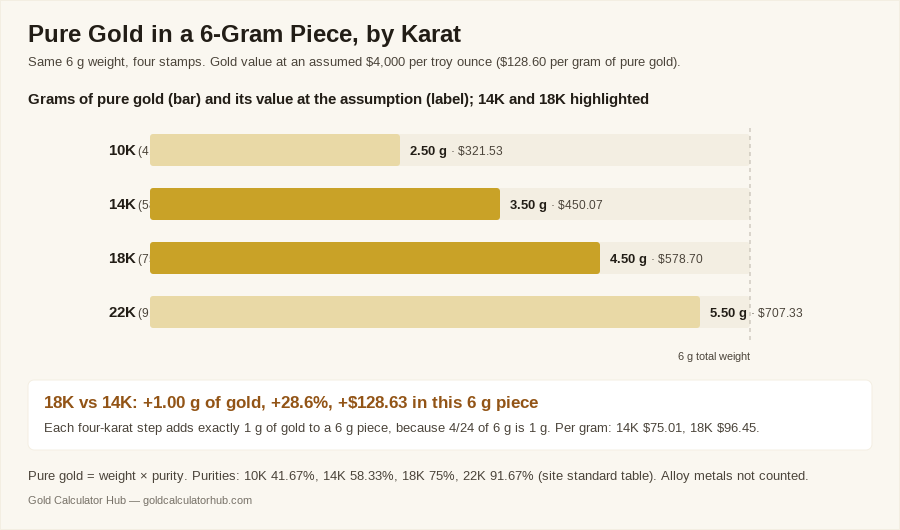
The chart shows the same thing in grams. In a 6-gram piece, every four-karat step adds exactly one gram of gold, because four twenty-fourths of 6 g is 1 g: 3.50 g of gold in 14K, 4.50 g in 18K.
One caution about comparing equal weights. The same ring design cast in 18K usually comes out a little heavier than in 14K, because gold is denser than the metals it is alloyed with. So the real gold gap between two versions of one design is somewhat larger than the same-weight figures above. When you are choosing between two actual pieces, weigh both.
Color, scratches and skin: where the two stamps differ once you wear them
Color. Three quarters of an 18K yellow piece is gold, and it shows: the yellow is deeper and warmer. 14K yellow is lighter and a touch paler. Next to each other the difference is easy to see; on its own, a 14K chain reads as plain gold to most people. In white gold the gap mostly vanishes, because white gold jewelry is normally finished with rhodium plating, and the plating is the color you see. When it wears through, the alloy underneath shows and the piece needs re-plating; the white gold value guide covers what that does and does not do to value.
Scratches and wear. Here the sources do not agree, and it is more useful to say so than to pick a side. Most retailer buying guides describe 14K as the more durable, more scratch-resistant choice, because it holds more alloy metal, and they steer people who work with their hands toward it for a ring worn every day. On enthusiast forums such as Pricescope, owners argue the point in both directions, and there is no consensus. No standards body publishes one hardness figure for "14K" or "18K", because each karat is a family of alloys whose recipe and manufacturing method matter too. A fair reading: both will scratch, 18K may show fine marks a little sooner, and a jeweler's polish removes most surface wear on either.
Skin. Reactions to gold jewelry come from the alloy metals, not the gold. Some white gold alloys contain nickel, a metal some people react to; others use palladium instead. A higher karat means less alloy overall, 25% in 18K against 41.67% in 14K, so 18K is the safer default for sensitive skin. If you want 14K white for the price, ask the jeweler what the alloy is and whether it is nickel-free.
Feel. Because the same design weighs more in 18K, a heavy chain or a wide band in 18K has a heft some people notice and like. In a pair of 2 g studs nobody will feel the difference.
The stamp. Both karats are legally defined marks. The FTC's Jewelry Guides, 16 CFR Part 23 govern how karat gold may be marked and described in the US. Watch for letters after the number: "14K GF" or "18K GP" means gold-filled or gold-plated over another metal, which is worth a small fraction of solid gold of the same stamp.
When is 18K worth paying for, and when is it not?
There is no universally right answer to 14K vs 18K gold; there is a better karat for a given person, piece and budget. Retail guides such as Brilliant Earth's 14K vs 18K guide (read November 19, 2026) describe 14K as the more common choice for rings in the US and 18K as the usual choice in much of Europe and Asia, but that is market habit, not a quality ranking. Work through the lists below.
18K tends to be worth paying for when:
- The wearer has reacted to jewelry before, or has known nickel sensitivity. Less alloy means less to react to.
- The piece is yellow gold and the color matters to you. The deeper yellow of 18K is the most visible difference between the two.
- The piece sees light wear: earrings, a pendant, a dress ring. Softness matters less when nothing rubs against it all day.
- You want more of the purchase price to be metal. Per gram, 18K keeps 28.6% more gold value, which is what any buyer pays for later.
14K is usually the better call when:
- The ring is worn every day by someone who is hard on their hands, and you follow the retailer guidance on durability.
- The piece is white gold. Rhodium plating hides most of the color difference, so you would be paying for gold you cannot see.
- The budget is fixed. The same money buys a heavier 14K chain, a wider band, or a better stone in a 14K setting.
Check the price gap against the gold gap before you pay. For an 8 g band, the gold difference between the two versions is $171.50 at the assumed price, a little more if the 18K casting is heavier. If the 18K version costs far more than that, the rest of the difference is labor, brand and margin. That may be worth it to you, but you pay it once and you do not get it back.
An illustrative case: a couple choosing matching 4 g bands. In 14K the pair holds $600.10 of gold; in 18K, $771.60. The $171.50 difference in metal is real, and if neither has sensitive skin and both want a pale yellow look that can take daily knocks, 14K delivers what they want and leaves the rest of the budget for something else. If one of them reacts to cheap metal, the 18K pair is the sensible spend.
Resale: the stamp sets the floor, the receipt does not
When you sell, a buyer tests the metal, weighs it and pays a share of melt. The design, the brand and the retail markup are not part of that number. So the stamp sets the floor for what comes back, and the price on the original receipt has almost nothing to do with it.
That cuts both ways in the 14K vs 18K gold comparison. An 18K piece returns 28.6% more per gram of the same weight, which is why 18K holds value better in a strict metal sense. But both karats lose the markup the moment they leave the store, whatever its size, and the 28.6% extra gold does nothing to recover it. If resale value is the main goal, jewelry in either karat is an expensive way to hold gold, because the markup is spent on day one.
To see what a piece you already own is worth, put its weight and karat into the gold calculator or follow the step-by-step value check. Two adjustments matter in practice:
- Stones and non-gold parts come out of the weight. A buyer pays for gold only. An illustrative 14K ring weighing 4.4 g on the scale, where the buyer estimates the stone and its setting at 0.4 g, leaves 4.0 g of 14K, $300.05 of gold at the assumed price. The gold ring value calculator handles this deduction for you.
- The test decides, not the stamp. Buyers verify karat with acid or an electronic analyzer. A genuine 585 or 750 piece passes; a worn or unclear stamp just gets tested. A plated piece stamped "14K" with a GP or HGE suffix will not be paid as solid gold.
A worked selling example: a 20 g 18K chain holds $1,929.00 of gold at the assumed price. At the typical refiner range of 70–90% that is $1,350.30 to $1,736.10; at a pawn shop's 40–60%, $771.60 to $1,157.40. The same chain in 14K holds $1,500.25, so $1,050.17 to $1,350.22 at a refiner. Get two quotes before you accept one: the spread between buyers is wide enough to swamp the karat difference, as the table in the first section shows.
The one piece of advice that applies to both karats: keep the receipt and a note of the weight when you buy. It helps with insurance, it helps you judge an offer later, and it lets you check that the weight a buyer reports matches what you brought in.
Frequently Asked Questions
Is 583 gold the same as 585?
Yes, both are 14K. Fourteen twenty-fourths is 58.33%, and makers round it to three digits in two different ways: 585 is the common modern mark, while 583 appears on older pieces and on jewelry from some countries. The 0.2-point difference is too small to change an offer, and buyers treat both as 14K. What matters more is that the piece tests as solid gold and that the stamp has no plating suffix after it.
Does 18K gold tarnish less than 14K?
Generally, yes. Pure gold does not tarnish; discoloration comes from the alloy metals reacting with skin, air and household chemicals. An 18K piece contains 25% alloy against 41.67% in 14K, so there is less metal available to react. In everyday wear neither should tarnish much, and a soft cloth or a jeweler's cleaning restores both. If a piece stamped 14K or 18K darkens quickly or turns your skin green, have it tested: that behavior is more typical of plated base metal.
Which is better for an engagement ring, 14K or 18K?
For a ring worn every day, most retailer guides lean toward 14K because of its extra alloy and lower price, while 18K is favored for its richer yellow and for wearers with sensitive skin. Forum owners argue the durability point both ways. A practical split: choose 18K for a yellow gold ring or a wearer who reacts to metals, 14K for a white gold ring (the rhodium plating hides the color difference) or for someone hard on their hands.
Can I tell 14K from 18K just by looking?
Sometimes, in yellow gold held side by side, because 18K is visibly deeper in color. On its own, or in white gold under rhodium plating, no. Light, skin tone and alloy recipe all shift how a piece looks. Read the stamp first, usually on the inside of a band or near a chain's clasp, and treat it as a claim to be checked rather than proof. A buyer or jeweler confirms karat with acid testing or an electronic analyzer.
Why does an 18K ring cost so much more than the gold in it?
Because a retail price includes design, labor, setting, brand and margin on top of the metal. At an assumed $4,000 per troy ounce, the gold in a 4 g 18K band is $385.80, and the 18K version holds only $85.75 more gold than the same band in 14K. Whatever the price gap is beyond that is not metal. It is a legitimate part of buying jewelry, but none of it comes back when the ring is sold for its gold.

Written by Sukie Gao
Sukie Gao holds a master's degree from a business school, where she picked up the markets-and-pricing toolkit she now applies to the consumer gold trade. She created Gold Calculator Hub to give people an independent, data-driven way to find out what their gold is really worth.
Published November 26, 2026